
Blog
Which Estate Items Need a Professional Appraisal? A Chicago Executor's Triage Guide
Not every item in a Chicago estate needs a credentialed appraiser, but IRS Form 706 and Illinois probate law both draw lines that determine which estate items need a professional appraisal and which can be listed in bulk. This guide gives executors a clear triage: what goes into a general inventory, and what belongs in the hands of a specialist.
Clearing out a family home while settling a Chicago estate can feel like standing in a room where every object might matter. It doesn't. Knowing which estate items need a professional appraisal, and which can be grouped and listed in a general inventory, is the difference between a filing that closes cleanly and one that draws questions from the IRS or the probate court months later. This guide walks through what can be bulk-listed, what needs a credentialed specialist, and how our personal property appraisal service for estate tax fits into that process.
How Should Executors Inventory Ordinary Household Goods?
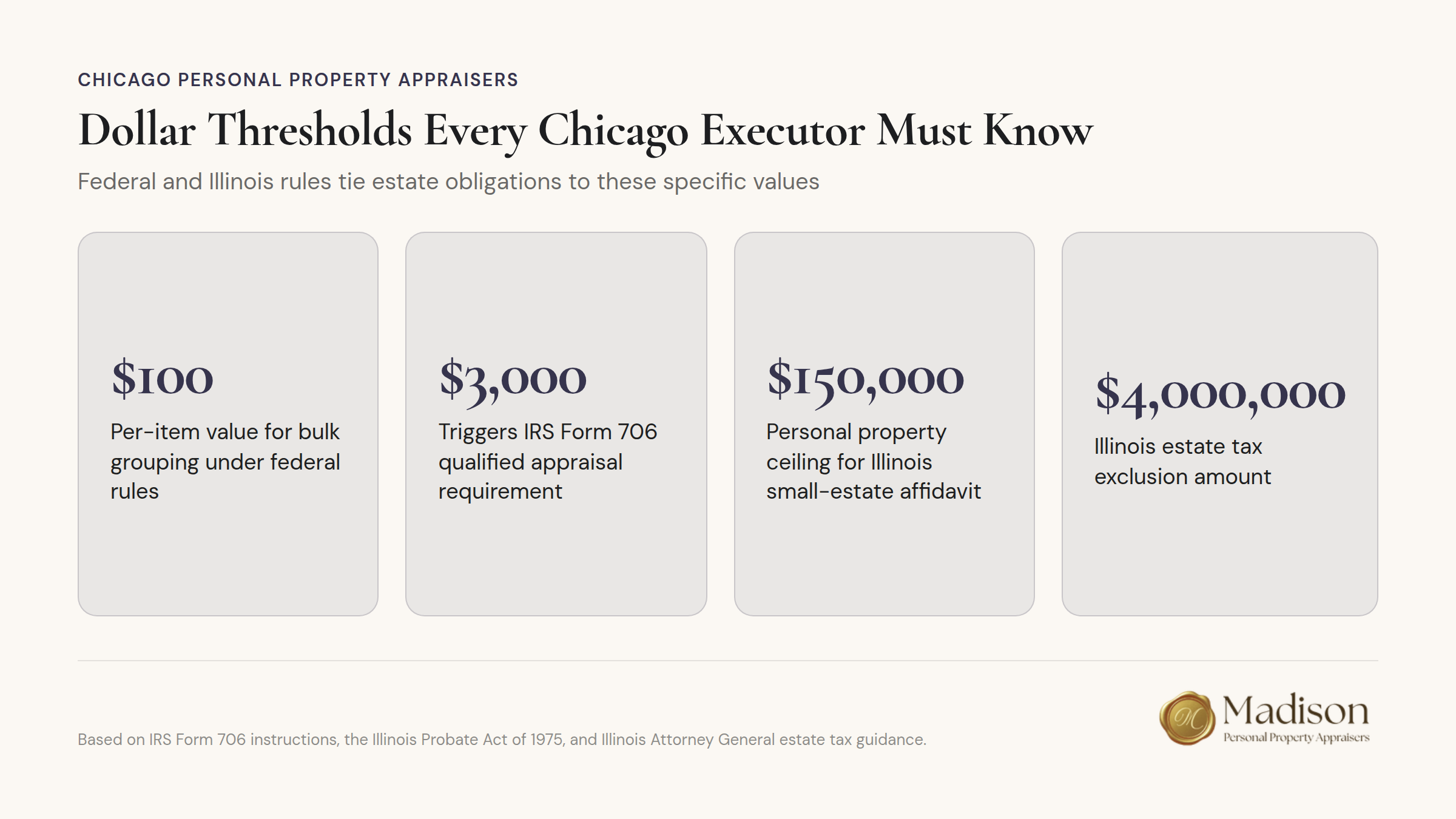
Ordinary household goods, furniture, linens, everyday kitchenware, common clothing, and standard dishware, are conventionally grouped and listed in bulk on an estate inventory rather than appraised item by item. Federal guidance on reporting household and personal effects supports this: Treasury Regulation 26 CFR 20.2031-6 calls for a room-by-room itemization but allows articles in the same room to be grouped together as long as none of them individually exceeds $100 in value.
That grouping rule is a convenience, not a loophole. A room full of everyday possessions can be listed as "contents of living room, minimal furnishings" in most cases. The work that actually matters is deciding which rooms, and which drawers, hold something that doesn't belong in that group.
Our FAQ on valuing personal possessions for Illinois probate walks through the inventory mechanics in more detail, but the short version is this: sort first, appraise second, and only appraise what the sort turns up.
Watch out: Bulk categories hide outliers more often than executors expect. A workshop full of common hand tools can contain a valuable antique molding plane. A cupboard of everyday dishes can contain a few pieces of collectible mid-century pottery mixed in with the rest. A linen closet can hold a hand-stitched quilt worth more than everything else in the room combined. Flag anything that looks out of place before it gets swept into the bulk listing.
Bulk Inventory vs. Item-Level Appraisal: A Quick Reference
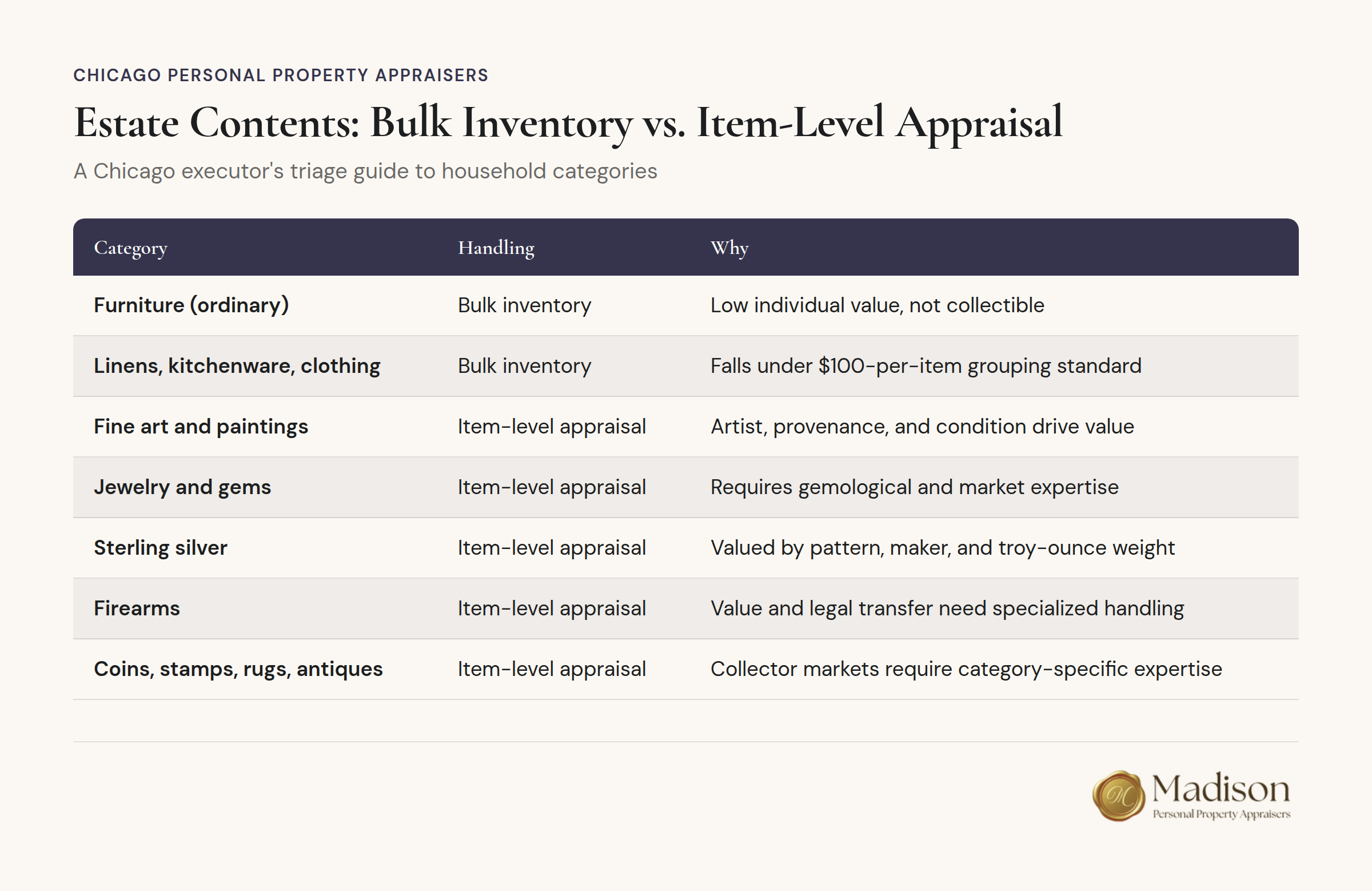
The table below summarizes how most Chicago-area estates handle common categories of household contents.
| Category | Typical Handling | Why |
|---|---|---|
| Furniture (ordinary) | Bulk inventory | Low individual value, not collectible |
| Linens, kitchenware, common clothing | Bulk inventory | Falls under the $100-per-item grouping standard |
| Fine art and paintings | Item-level appraisal | Artist, provenance, and condition drive value |
| Jewelry and gems | Item-level appraisal | Requires gemological and market expertise |
| Sterling silver | Item-level appraisal | Valued by pattern, maker, and troy-ounce weight |
| Firearms | Item-level appraisal | Value and legal transfer both require specialized handling |
| Coins, stamps, rugs, antique furniture | Item-level appraisal | Collector markets require category-specific expertise |
Category-by-Category: Why Each Asset Type Needs a Specialist
Fine Art and Paintings
A painting's value depends on the artist, the period, the condition, and the current collector market for that specific name or school, none of which a general household inventory can capture. If a piece has real artistic merit, our appraisers document the size, subject, artist, medium, and condition, the same detail level a court or the IRS would expect to see supporting a stated value.
Jewelry and Gems
Jewelry is specialized enough that a qualified jewelry appraiser is almost always necessary once a piece moves past costume jewelry into fine gems, precious metals, or estate pieces with an unclear origin. Executors frequently underestimate or overestimate jewelry value by relying on a retail replacement figure or an old insurance rider, and general guidance on estate personal property recognizes that gems and jewelry sit outside what a non-specialist can reliably price (executorium.com).
Sterling Silver
Sterling silver flatware and hollowware are typically valued by pattern, maker, and weight in troy ounces, separate from any silver-plated pieces that don't carry the same intrinsic metal value. Before an appraiser arrives, it helps to have the full service gathered together and the sterling separated from the silverplate; that single step saves significant time in the appraisal itself.
Firearms, Including NFA and Class 3 Items
Firearms need appraisal for value and separate handling for legal transfer, and those two things are not the same task. Standard firearms can typically be appraised and inventoried like other collectibles. NFA-regulated items, such as suppressors, short-barreled rifles, or fully automatic weapons, generally cannot be lawfully possessed or transported by an executor who isn't the registered owner, and transfer usually has to run through a licensed FFL dealer before the item can even be appraised or distributed. Flag any firearm that looks unusual, older, or modified for a specialist review before it moves anywhere.
Collectibles: Coins, Stamps, Rugs, and Antique Furniture
Coin and stamp collections, oriental rugs, and antique furniture all trade in collector markets that a general estate inventory can't price accurately. Coins are valued by grade, mint mark, and rarity; rugs by size, make, and condition; antique furniture by maker, period, and originality of finish. Good books in matched sets by standard authors fall into this same bucket when the set has real collector value rather than simple shelf presence.
The IRS and Illinois Thresholds That Make This a Compliance Issue
This isn't only a matter of getting a fair number. Both federal and Illinois rules attach specific dollar thresholds to how household contents must be reported, and crossing one without the right documentation can slow down or reopen an estate.
On the federal side, the IRS Form 706 instructions require that if the decedent owned works of art or collectible items, such as jewelry, furs, silverware, books, statuary, or coin and stamp collections, and any single item or collection of similar items is valued at more than $3,000, an appraisal by a qualified, disinterested appraiser must be filed with the estate tax return, sworn under oath and accompanied by a statement of the appraiser's qualifications.
On the Illinois side, the personal representative has a statutory duty to inventory the estate's personal property and may hire one or more competent, disinterested appraisers when valuation is needed for proper administration, under the Illinois Probate Act of 1975. Illinois courts and practitioners commonly treat an estate with roughly $150,000 or less in personal property as eligible for the streamlined small-estate affidavit process rather than full probate administration, which is one more reason to know early whether the household contents push the estate over that line.
Illinois also imposes its own estate tax separate from the federal one. The Illinois Attorney General's estate tax guidance sets the current Illinois estate tax exclusion amount at $4,000,000, above which the estate may owe Illinois estate tax regardless of the federal outcome. For estates near that line, an accurate, defensible valuation of the high-value contents can matter as much as the real estate and financial accounts.
Our guide to Cook County probate rules on personal property appraisals covers the local filing mechanics in more depth, including how Cook County courts typically expect these appraisals to be presented.
Where Bulk Sorting Ends and Our Appraisers Start
Most estates split cleanly into two piles: everyday contents that a family can sort and list themselves, and a smaller set of items that need a credentialed appraiser's signature behind the number. Our appraisers hold credentials with organizations such as the ASA, ISA, and AAA, and every report we prepare follows the standards published by The Appraisal Foundation, so the valuation holds up whether it's reviewed by the IRS, a probate judge, or an estate attorney.
Personal property appraisal engagements for estate purposes are quoted as a fixed fee after we scope the assignment, generally starting around $195 for standard reporting or $295 when the report needs to meet IRS-qualified standards, with the final fee scaled to how many categories and items are involved. There's no hourly billing and no guessing at the cost before the work begins.
The family's job is to walk the house, group the ordinary contents, and flag anything that looks unusual, valuable, or unfamiliar. Our job is to take it from there: putting a defensible, USPAP-compliant value on the fine art, jewelry, silver, firearms, and collectibles that the IRS and Illinois probate law actually expect to see documented at the item level.
This article is provided for general informational purposes only and does not constitute legal, tax, or financial advice. Readers should consult a qualified attorney or CPA regarding their specific circumstances.