
Blog
Illinois Small Estate Affidavit: When Cook County Still Requires a Personal Property Appraisal
The Illinois small estate affidavit lets heirs skip probate court for personal property under $150,000, but it doesn't erase the need for a defensible valuation. Here's when Cook County heirs can rely on a simple estimate and when a professional appraisal still protects them.
Settling a loved one's estate in Cook County often starts with a simple question: do we really need a lawyer and a court docket for a modest house full of furniture, jewelry, and family keepsakes? For many Illinois families, the answer is no. The small estate affidavit lets an heir collect and distribute a decedent's personal property without opening a formal probate case. But skipping probate court is not the same thing as skipping a valuation, and conflating the two is where heirs run into trouble later with the IRS, with each other, or with a charity's documentation requirements.
This guide walks through what the affidavit actually requires, where the $150,000 threshold comes from, and the specific situations where our personal property appraisal for estate tax services still matter even after the affidavit has done its job.
What the Illinois Small Estate Affidavit Actually Does
The small estate affidavit, codified at 755 ILCS 5/25-1, allows a person holding a decedent's personal property (a bank, a landlord, a family member) to turn that property over to the people named in the affidavit without waiting for a probate court to issue letters of office. No judge reviews the affidavit before the property changes hands. No inventory gets filed with the clerk. The affiant simply signs a sworn statement listing the assets and their values and certifies that the statutory conditions are met.
That shortcut is powerful, but it comes with conditions. Under the statute, the affidavit is only available when:
- No letters of office have been issued and none are pending or contemplated, in Illinois or any other state.
- The statutory waiting period and creditor-related requirements under the Illinois Probate Act have been satisfied.
- The decedent's qualifying personal estate falls within the statutory dollar ceiling.
Cook County does not set its own threshold or its own exemption from appraisal. The $150,000 ceiling and the conditions for using the affidavit come from state law and apply the same way in Cook County as anywhere else in Illinois. What differs locally is simply where the affidavit gets presented, whether that's a bank branch in Oak Park or a brokerage downtown, and what supporting paperwork that institution asks for on top of the sworn affidavit itself.
The $150,000 Threshold and What Counts Toward It
For deaths occurring on or after August 15, 2025, an estate qualifies for the small estate affidavit when the decedent's personal estate, valued at fair market value, does not exceed $150,000, under 755 ILCS 5/25-1. This replaced the prior $100,000 limit. A few points matter here:
- The figure is gross value, not net value. Debts, funeral costs, and administration expenses are not subtracted when testing against the ceiling.
- The property counted includes both tangible and intangible personal property passing by will or by intestacy, such as household goods, jewelry, collections, bank accounts, and investment holdings.
- Registered motor vehicles and mobile homes are treated separately under the amended statute and generally are not folded into the $150,000 personal property total the same way other assets are.
- Property passing outside probate, such as certain jointly titled accounts or assets with named beneficiaries, is usually governed by its own transfer mechanism and sits outside the affidavit calculation entirely.
Notice what the statute requires here: a valuation at fair market value, not a formal appraisal performed by a credentialed appraiser. The Illinois small estate affidavit form asks the affiant to list each asset and its fair market value. For household goods, furniture, and ordinary collections, that typically means a reasonable, good-faith estimate as of the date of death, not an item-by-item professional appraisal. Illinois law simply does not impose a blanket requirement that every object pass under an appraiser's eye before the affidavit can be used.
Watch out: A reasonable estimate still has to be defensible. If a bank, a co-heir, or eventually the IRS questions the stated values, the affiant is the one who signed a sworn statement attesting to them.
Why the Affidavit Is a Probate Shortcut, Not a Valuation Shortcut
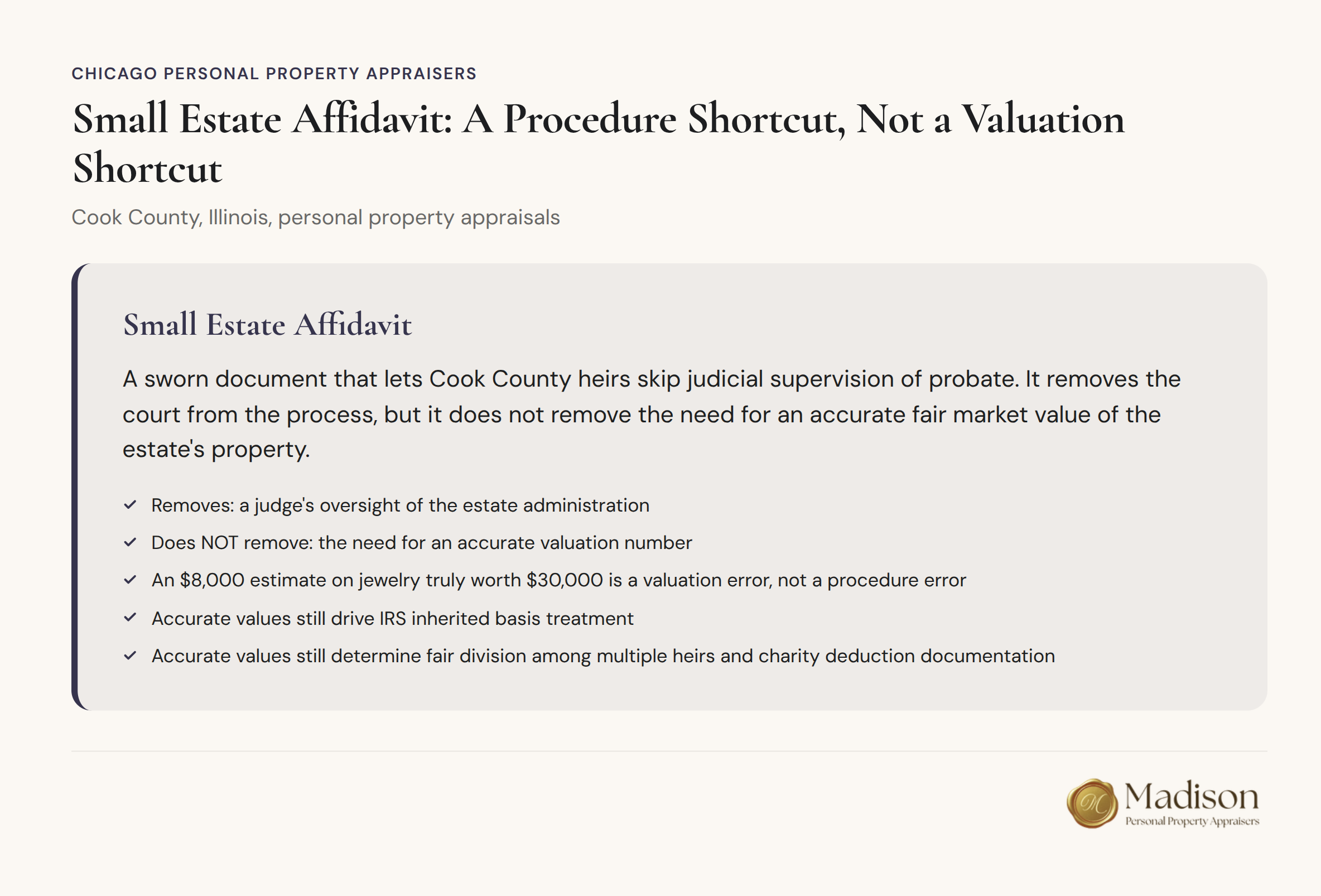
Here is the distinction that trips up a lot of Cook County families: the affidavit removes the court from the process, it does not remove the need for an accurate number from the process. Those are two separate problems, and the affidavit only solves one of them.
An affiant who estimates a jewelry collection at $8,000 when it is genuinely worth $30,000 has made an error that has nothing to do with probate procedure and everything to do with how that property gets taxed, divided, or donated later. The affidavit lets heirs skip a judge's supervision; it does not change how the IRS treats inherited basis, how multiple heirs divide specific items fairly, or what documentation a charity needs for a deduction. For a closer look at how Cook County probate handles personal property more broadly, see our guide on what Cook County probate law says about personal property appraisals.
When a Professional Appraisal Still Matters After the Affidavit
A professional appraisal becomes relevant the moment the estate's assets intersect with tax reporting, a dispute between heirs, or a charitable gift, regardless of whether a small estate affidavit was used to transfer the property. A few scenarios come up repeatedly in Cook County estates.
Stepped-Up Basis When Heirs Later Sell
When heirs inherit property, the tax code generally adjusts the asset's cost basis to its fair market value at the date of death. That stepped-up basis determines the taxable gain or loss when the heir eventually sells the item, whether it's a car, a coin collection, or a piece of art. If no one documented the fair market value at the date of death, the heir may have no defensible basis to point to years later when a sale triggers a tax question. A contemporaneous appraisal creates that record while memories and documentation are still fresh.
Equitable Distribution Disputes Among Multiple Heirs
When several siblings or heirs are dividing collectibles, jewelry, firearms, or art rather than simply splitting cash, a rough household estimate rarely satisfies everyone. One heir's estimate of what grandmother's ring is worth is not the same as an independent, documented opinion of value. An appraisal gives all parties a neutral, defensible figure to divide the estate against, which tends to prevent disputes from reopening months after the property has already changed hands.
Charitable Donation Deductions Over $5,000
If heirs donate inherited items (art, antiques, a gun collection, sports memorabilia) to a museum or charity, and the claimed deduction for an item or a group of similar items exceeds $5,000, the IRS requires a qualified appraisal and a completed Form 8283 to support the deduction. Our page on what the requirements are for filing Form 8283 walks through exactly what the IRS expects in that report. A small estate affidavit's informal estimate does not meet that standard; it was never designed to.
Voluntary or Required Estate Tax Filings
Illinois imposes its own estate tax separate from the federal estate tax, and personal property values feed directly into that calculation when a filing is required or voluntarily made to establish basis. Our team prepares reports for exactly this purpose through our personal property appraisal for estate tax service, and our guide on how Illinois estate tax treats personal property covers the filing mechanics in more depth.
Ordinary Household Goods vs Specialized or High-Value Items
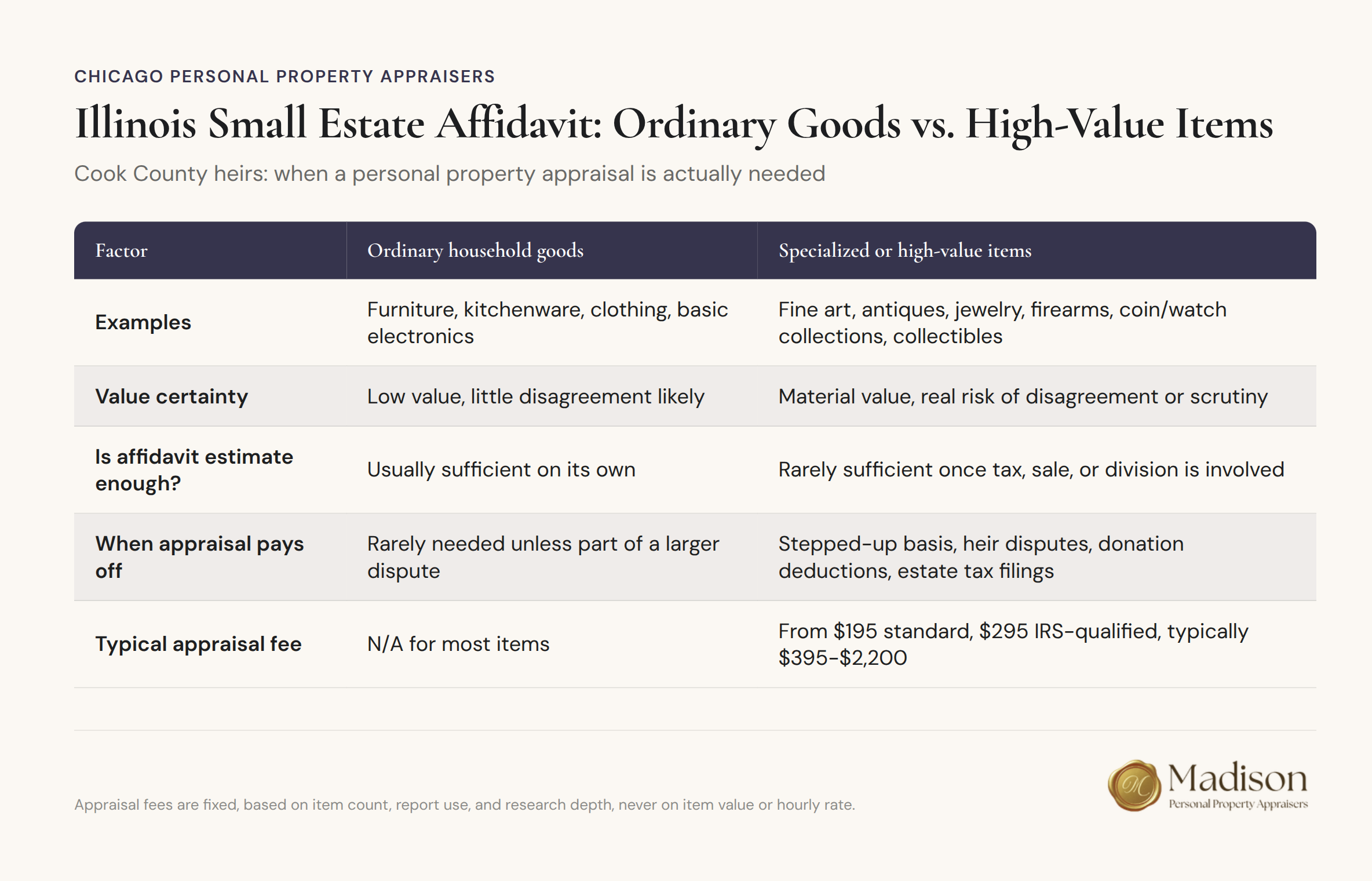
Not every item in an estate needs the same level of scrutiny. The table below shows how the two ends of the spectrum typically shake out for Cook County heirs using the affidavit.
| Factor | Ordinary household goods | Specialized or high-value items |
|---|---|---|
| Examples | Everyday furniture, kitchenware, clothing, basic electronics | Fine art, antique furniture, jewelry, firearms, coin or watch collections, significant collectibles |
| Typical value certainty | Low value, little disagreement likely | Material value, real risk of disagreement or scrutiny |
| Affidavit-level estimate | Usually sufficient on its own | Rarely sufficient once tax, sale, or division is involved |
| When an appraisal pays for itself | Rarely needed unless part of a larger dispute | Stepped-up basis documentation, heir disputes, donation deductions, estate tax filings |
| Typical appraisal fee range | N/A for most items | From $195 standard, from $295 IRS-qualified, typically $395 to $2,200 depending on scope |
Our fees for personal property appraisal are quoted as a fixed fee before any work begins, based on the number of items, the intended use of the report, and the depth of research required, never on the item's value or an hourly rate. An engagement covering a few specialized pieces for an estate tax or donation purpose typically falls in the lower end of that range; a larger collection with more complex research needs runs higher.
Confirm Eligibility Before You Rely on the Affidavit
We are a personal property appraisal firm, not a law practice, so we won't tell you definitively whether your specific estate qualifies for the small estate affidavit. That determination, including whether letters of office are pending anywhere, whether creditor notice requirements have been satisfied, and how to properly complete the statutory form, belongs with a probate attorney or the Cook County probate clerk's office. What we focus on is the other half of the equation: producing a fair market value opinion that holds up if the IRS, a co-heir, or a charity ever asks how a number was reached.
Our appraisers hold credentials with organizations such as the ISA, ASA, AAA, and CAGA, and every report we prepare follows the Uniform Standards of Professional Appraisal Practice. That combination of credentialing and standards compliance is what turns a reasonable estimate into a defensible one.
Getting the Valuation Right, Even When Probate Court Isn't Involved
The small estate affidavit does real work for Cook County families: it keeps modest estates out of a courtroom and gets property into heirs' hands faster. But the affidavit's $150,000 threshold and its fair-market-value standard were built for a narrow purpose, clearing title to transfer property, not for settling tax basis, resolving sibling disputes, or substantiating a charitable deduction. Those downstream uses have their own documentation standards, and a household guess rarely satisfies them.
If your estate includes jewelry, art, firearms, collections, or anything else where the value is more than a rough guess, it's worth getting a professional opinion on record while the details are still fresh. Request an appraisal and our team will scope the assignment to exactly what your situation requires.
This article is provided for general informational purposes only and does not constitute legal, tax, or financial advice. Readers should consult a qualified attorney or CPA regarding their specific circumstances.