
Blog
What Happens If the IRS Questions Your Chicago Charitable Donation Appraisal
An IRS review of a charitable donation appraisal and Form 8283 filing turns on a handful of specific red flags, not bad luck. Here's what triggers scrutiny, what a Chicago donor should keep on file, and what a reduced or disallowed deduction actually costs.
If you donated art, antiques, or a houseful of estate contents to a Chicago-area charity and claimed a deduction over $5,000, your Form 8283 filing is the document that decides whether the IRS accepts your valuation without a second look. The IRS does not review every noncash contribution, but when it does, the review almost always traces back to a small set of specific problems: a missing signature, an appraiser who should not have been used, or a value that does not match the appraisal report behind it. This guide walks through why the IRS flags a filing, the specific red flags that invite scrutiny, what documentation to keep on hand, and what a reduced or disallowed deduction can actually cost you. Our personal property appraisal for charitable donation service exists specifically to keep a Chicago donor's paperwork out of that second-look pile.
Why the IRS Flags a Form 8283 Filing for Review
The IRS flags a Form 8283 filing when the paperwork itself signals a problem, not because it disagrees with the donation. Section B of Form 8283 is an appraisal summary. It is not the appraisal, and the IRS Form 8283 Instructions make clear that the summary exists to show the IRS what the underlying qualified appraisal says, who prepared it, and when.
When the summary is incomplete, unsigned, or inconsistent with the numbers a reviewer would expect for a similar item, the return gets a closer look. According to the IRS's own description of how it reviews donated-property valuations, examiners can contact the taxpayer for more information, refer the valuation to an IRS appraiser or valuation specialist, or refer high-value art to the Art Appraisal Services unit, which consults with the Commissioner's Art Advisory Panel on major art and collectible donations. None of that requires the IRS to prove anything is wrong first. A gap in the paperwork is often enough to start the process.
The Red Flags That Trigger IRS Scrutiny
Most IRS challenges to a charitable donation appraisal come from a small, predictable list of filing defects rather than an honest disagreement over value. A Chicago donor filing Form 8283 Section B for a gift over $5,000 should check the return against every item on this list before it goes out:
- Missing Declaration of Appraiser signature. Section B requires the appraiser to sign the form, and the donee organization generally must sign as well unless a specific exception applies. A missing signature is one of the easiest defects for the IRS to spot on its face.
- An excluded appraiser prepared the report. IRS Publication 561 sets out who cannot serve as the qualified appraiser for a donation, including the donor, the donee organization, a party to the transaction in which the donor acquired the property, or anyone related to those parties. An appraisal from an excluded individual is not a qualified appraisal at all, regardless of how detailed it is.
- The appraisal was completed too late or too early. Treasury Regulation 1.170A-13(c) requires the qualified appraisal to be made no earlier than 60 days before the contribution date, and the donor must receive it before the filing deadline (including extensions) of the return on which the deduction is first claimed.
- The claimed fair market value looks aggressive against comparable items. IRS Publication 561 describes the accepted methods for determining fair market value, including comparable sales, and a valuation that departs sharply from what similar items have sold for is a natural trigger for closer review.
- The appraisal report is missing required elements. A qualified appraisal has to include specifics: a description of the property, the valuation date, the method of valuation, the appraiser's qualifications, and the basis for the conclusion. A report that skips any of these does not meet the standard even if the number itself is defensible.
Getting the Form 8283 filing requirements right the first time is the single most effective way to avoid an unnecessary look from the IRS. None of these red flags are about the honesty of the donor. They are about whether the paperwork itself does what the regulations require.
What Documentation Should You Keep on Hand?
A Chicago donor should be ready to produce five categories of records if the IRS asks about a donation, whether or not that documentation was required to be attached to the original return. Keeping these organized from the start is far easier than reconstructing them during an inquiry:
- The qualified appraisal itself. Even when the appraisal was not required to be attached to the return (donations between $5,000 and $500,000 generally do not require the full appraisal as an attachment), the donor should keep the complete report as long as it may be relevant.
- Photographs of the donated items. Clear photographs taken close to the date of the gift help establish condition and identity, and they support the description the appraiser used in the report.
- Provenance and purchase records. Receipts, prior appraisals, auction records, or family documentation showing how and when the donor acquired the property.
- Comparable sales data. The specific sales or listings the appraiser relied on to support the fair market value conclusion, not just the conclusion itself.
- The appraiser's qualifications. Credentials, experience, and a statement confirming the appraiser meets the definition of a qualified appraiser under IRS standards, since an unqualified appraiser can unwind the entire deduction regardless of the number reported.
What You Risk If the IRS Reduces or Disallows Your Deduction
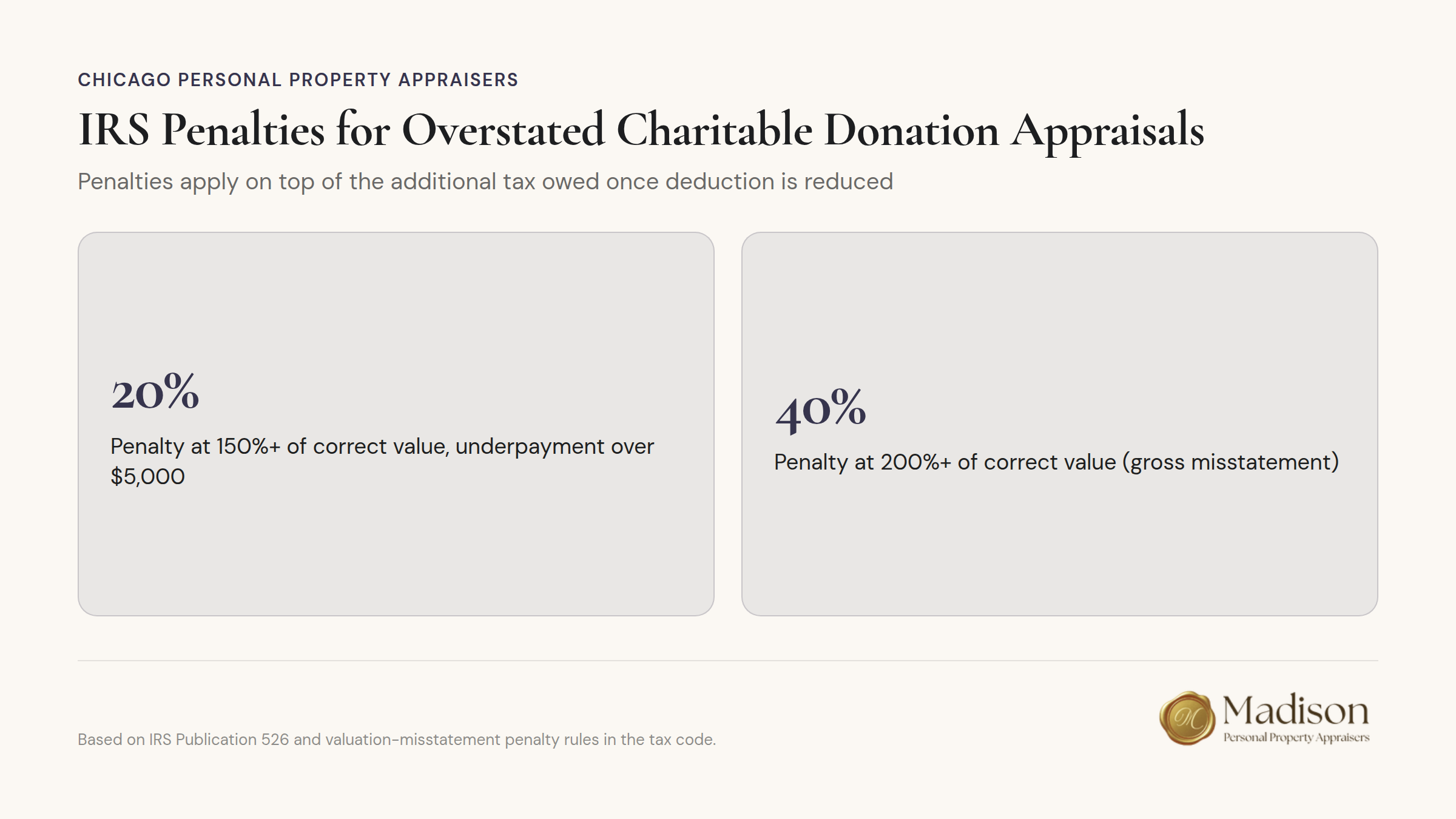
The financial exposure from a failed appraisal review goes beyond simply losing the deduction. If the IRS determines the claimed value was too high, Publication 526 describes an accuracy-related penalty that applies when the value claimed is 150% or more of the correct amount and the resulting underpayment exceeds $5,000. That penalty runs 20% of the underpayment. If the overstatement is more severe, at 200% or more of the correct value, the penalty structure under the valuation-misstatement rules in the tax code steps up to 40% of the underpayment. These are penalties on top of the tax the donor owes once the deduction is reduced, not a replacement for it.
The exposure is not limited to the donor. An appraiser who prepares a report resulting in a substantial or gross valuation misstatement can face a separate penalty under the tax code aimed specifically at appraisers who knew, or reasonably should have known, that their valuation would be used in connection with a return and that it substantially overstated value. That penalty structure is one reason a reputable appraiser will not inflate a number to make a donor happy: the professional risk runs in the same direction as the donor's.
Example: A donor claims a $60,000 deduction for a collection of antique silver. The IRS later determines the correct fair market value was $35,000, which is roughly 171% of the corrected figure. That crosses the 150% threshold, and if the resulting underpayment exceeds $5,000, the donor faces a 20% penalty on the underpayment in addition to owing the additional tax.
How a Complete, USPAP-Compliant Appraisal Holds Up Under Review
The IRS, not any appraiser or appraisal firm, decides whether a claimed value stands. What a donor can control is whether the appraisal itself gives the IRS nothing to flag. That means a report prepared in accordance with USPAP (the Uniform Standards of Professional Appraisal Practice, published by The Appraisal Foundation), by an appraiser who is not an excluded party, completed within the correct timing window, and containing every element the regulations require: description, valuation date, methodology, comparable data, and appraiser qualifications.
Our appraisers hold credentials with organizations such as the ISA, ASA, and AAA, and every charitable donation report we prepare is built to the same standard: complete, properly dated, and structured so a Chicago donor's Form 8283 filing matches the appraisal behind it line for line. We do not promise the IRS will accept any particular value; that determination belongs to the IRS. What we do is remove the paperwork defects, the missing signatures, the excluded appraisers, the incomplete reports, that turn an honest donation into a drawn-out inquiry.
If you are preparing to file Form 8283 Section B for a Chicago-area donation, or if the IRS has already sent a letter asking questions about one you filed, request an appraisal from our team before you respond. A complete, defensible report is the best answer to almost every question the IRS is likely to ask.
This article is provided for general informational purposes only and does not constitute legal, tax, or financial advice. Readers should consult a qualified attorney or CPA regarding their specific circumstances.