
Blog
What Happens When the IRS Flags Your Chicago Donation Appraisal as Overvalued
An overstated charitable donation appraisal can trigger an IRS accuracy-related penalty of 20% to 40% once the resulting underpayment exceeds $5,000. This guide explains the penalty brackets, the Form 8283 dollar thresholds, and how a properly documented appraisal protects a Chicago donor's deduction.
The IRS does not need to prove fraud to create a serious problem for a Chicago donor who overstates the value of a collection. It only has to show that the claimed value was too high, and from there the consequences move quickly: a reduced deduction, back taxes, and often an accuracy-related penalty on top of both. This matters most for art, antiques, and other collectibles, where valuation is inherently judgment-based and easy for the IRS to challenge after the fact.
This guide walks through what actually triggers that scrutiny, how the penalty brackets work under the tax code, what happens to the appraiser who signed off on an inflated number, and how a properly documented appraisal from our personal property appraisal service for charitable donations keeps a donor out of this situation in the first place.
What Triggers IRS Scrutiny of a Donated Collection's Value
The IRS generally reviews a non-cash charitable deduction when the claimed value looks disconnected from the market a buyer would actually pay in. Common red flags include values based on retail replacement cost rather than fair market value, appraisals that rely on a single high comparable instead of a representative sample, and collections valued item-by-item without accounting for how the whole group would realistically be sold together.
A useful illustration from long-standing IRS practice: a taxpayer once donated a large collection of outdated books and claimed a deduction based on the retail price of comparable new titles. The IRS determined that the only realistic market for that taxpayer's collection was a sale to a used-book dealer, and the allowed deduction came in far below what was claimed. The lesson generalizes to any Chicago collection: the appraiser has to identify the market the donor would actually have sold into, not the most favorable market that exists somewhere.
Once the IRS questions a value, it can accept the number as filed, request more information, or refer the file to an internal valuation specialist for an independent determination of fair market value. If the IRS concludes the appraisal was wrong, it recalculates the deduction, the taxable income, and the tax owed, and that recalculation is what opens the door to a penalty.
The Form 8283 Dollar Thresholds That Apply to Your Donation
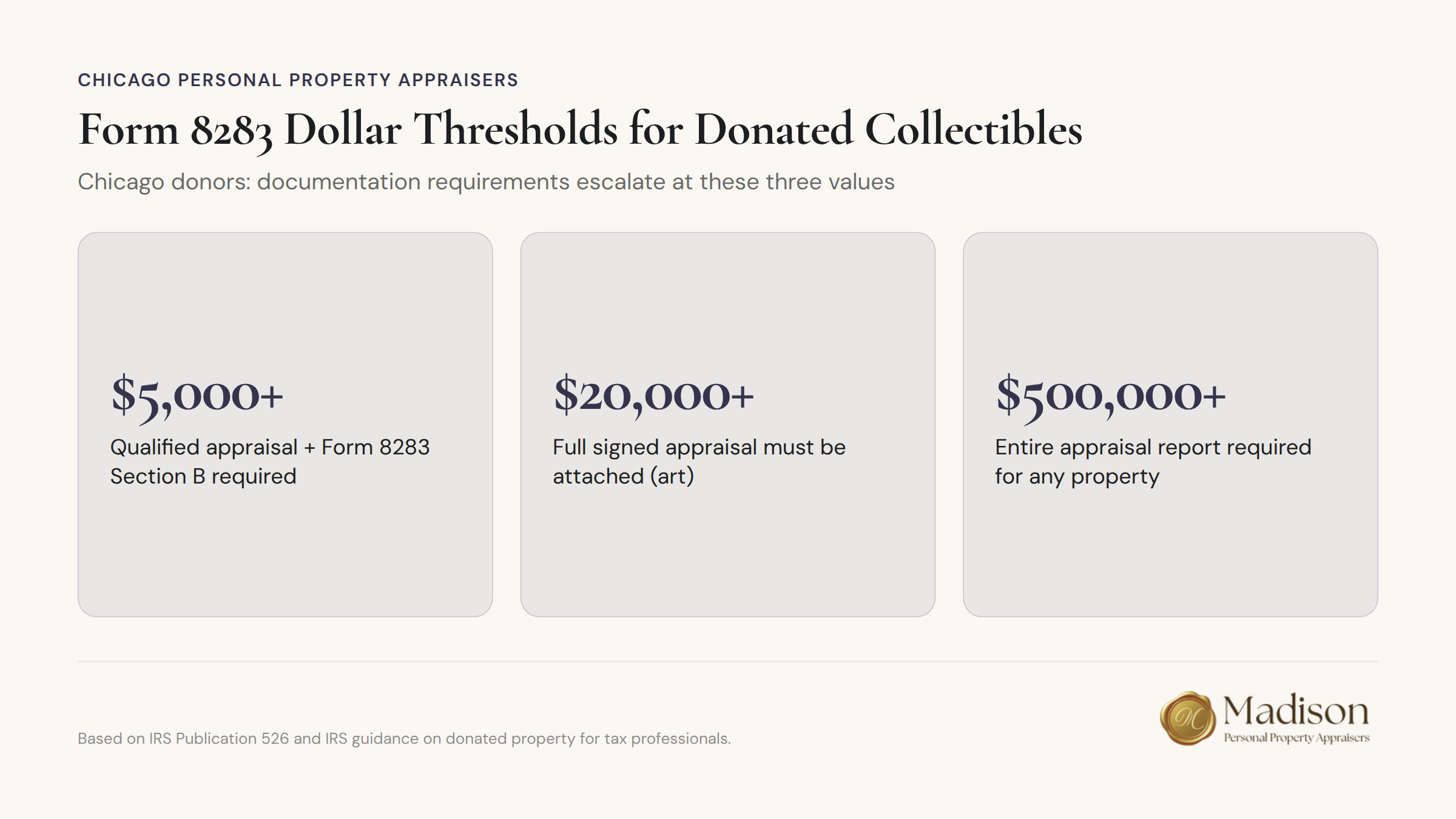
Any non-cash donation over $5,000 requires a qualified appraisal and a completed Form 8283, Section B, as described in the IRS Publication 526 guidance on charitable contributions. Below that threshold, a receipt or reasonable estimate is usually sufficient.
Art and collectibles carry two additional thresholds that Chicago donors and their CPAs should track:
- $5,000 and above: A qualified appraisal and Form 8283, Section B are required, though the appraisal itself does not need to be attached to the return.
- $20,000 and above (art specifically): The complete, signed qualified appraisal must be attached to the tax return, not just referenced or summarized.
- $500,000 and above: The entire appraisal report must be attached for any donated property at this value, regardless of category, as outlined in IRS guidance on donated property for tax professionals.
For a deeper breakdown of which section of the form applies and what documentation each one demands, see our guide to Form 8283 Section A versus Section B.
Substantial vs Gross Valuation Misstatement: How the Penalty Brackets Work
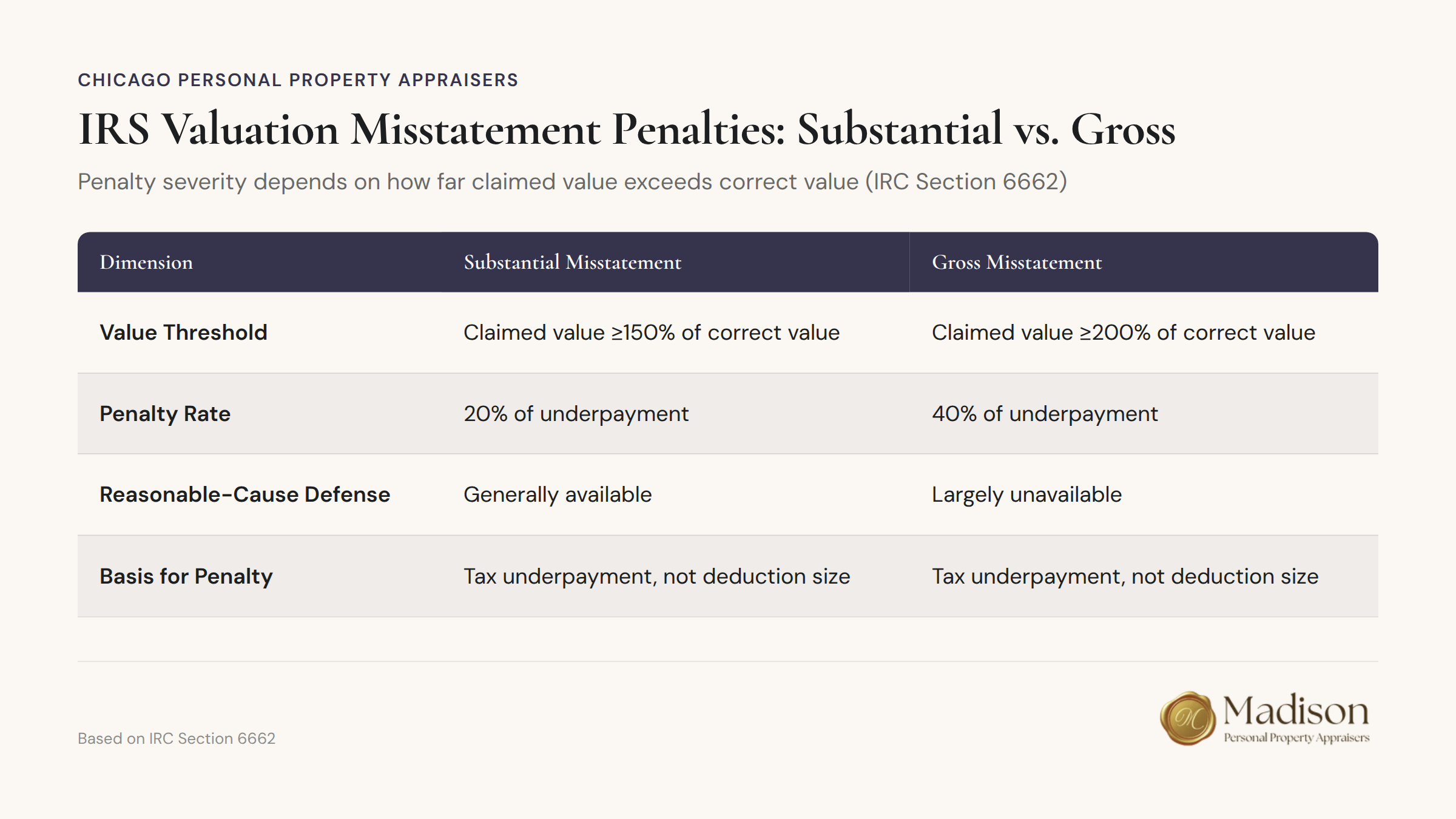
If the IRS determines your Chicago collection was overvalued, the accuracy-related penalty that follows depends on how far off the claimed value was, not on the dollar amount of the collection itself. The tax code sets two tiers, described in IRC Section 6662:
- Substantial valuation misstatement: The claimed value is 150% or more of the correct value. This triggers a 20% penalty on the portion of the tax underpayment attributable to the overstatement.
- Gross valuation misstatement: The claimed value is 200% or more of the correct value. This triggers a 40% penalty on the related underpayment, and the usual reasonable-cause defenses are largely unavailable at this level.
Example: A donor claims a $1,000,000 deduction for a collection that the IRS later values at $400,000. That claimed figure is 250% of the correct value, squarely in gross-misstatement territory. If the resulting underpayment exceeds the statutory floor, the donor faces a 40% penalty on the additional tax owed, calculated on top of the tax itself.
Key takeaway: The penalty is calculated on the tax underpayment, not on the appraised value or the size of the deduction. A smaller collection with a wildly inflated appraisal can trigger the same penalty percentage as a large one.
The $5,000 Underpayment Floor
The accuracy-related penalty does not apply just because a value was wrong. For individual taxpayers, the tax underpayment caused by the misstatement generally has to exceed $5,000 before the penalty kicks in, a threshold detailed in the IRS Internal Revenue Manual's accuracy-related penalty guidance. For corporations other than S corporations and personal holding companies, that floor is generally $10,000.
Watch out: A modest overstatement on a modest collection may never reach the $5,000 underpayment floor and therefore never trigger the penalty, but it can still cost the donor the full value of the disallowed deduction. Avoiding the penalty is not the same as avoiding a loss.
A qualified appraisal does not automatically shield a donor from this penalty either. The reasonable-cause exception generally requires that the donor relied on a qualified appraisal from a qualified appraiser and made a good-faith investigation into the property's value. That protection disappears entirely for a gross valuation misstatement, where the statute removes the reasonable-cause defense as a matter of law.
Appraisers Face Their Own Penalty for Overstated Values
The donor is not the only one exposed. An appraiser who knew, or reasonably should have known, that an appraisal would be used to support a tax return and that it would produce a substantial or gross valuation misstatement can face a separate penalty under the tax code, discussed in IRS Notice 2006-96. In plain terms, that penalty is generally the smaller of 10% of the resulting tax underpayment (with a $1,000 minimum) or 125% of the fee the appraiser was paid for the report.
This is part of why a credentialed, independent appraiser has every incentive to get the number right rather than inflate it to please a client. An appraiser can avoid this penalty by demonstrating the concluded value was more likely than not correct, which is exactly what a well-documented, methodology-driven report is built to show.
How a USPAP-Compliant Appraisal Reduces Your Audit Risk
The single best defense against an overvaluation penalty is an appraisal that would hold up if the IRS ever pulled the file and asked hard questions about it. Our appraisers hold credentials with organizations such as the International Society of Appraisers (ISA), the American Society of Appraisers (ASA), and the Appraisers Association of America (AAA), and every report is prepared in accordance with the Uniform Standards of Professional Appraisal Practice set by The Appraisal Foundation.
A defensible report for a Chicago donor's art, antiques, or collectibles generally includes the following:
- Comparable sales data drawn from the correct market. Fair market value depends on the market the donor would realistically sell into, not the highest retail price found anywhere, a principle laid out in IRS Publication 561.
- Documented methodology. The report explains how each comparable was selected and why it's relevant, rather than presenting a bare number.
- Condition, provenance, and authenticity analysis. These factors move value significantly for art and antiques and need to be addressed explicitly, not assumed.
- Compliance with the Form 8283 Section B content requirements. A report prepared with the IRS's qualified appraisal definition in mind from the outset avoids the scramble to fix gaps after a CPA flags them.
Pro tip: If your Chicago collection includes several categories (furniture, silver, art, jewelry), ask your appraiser to document the aggregation rules clearly. Similar items donated to the same organization during the same tax year are combined for purposes of the $5,000 and $20,000 thresholds, even if no single item would trigger them alone.
Protect Your Deduction Before You File
An overvalued Chicago donation appraisal rarely starts as an attempt to game the system. It is usually the product of a rushed estimate, a retail price substituted for fair market value, or a report that never engaged with the specific market for the donated items. The fix is the same regardless of the cause: a qualified, USPAP-compliant appraisal prepared before you file, built on real comparable sales and documented reasoning that can stand up if the IRS asks questions.
If you are preparing a non-cash charitable donation in the Chicago area, our team can request an appraisal scoped to your collection's size and complexity, with a fixed fee quoted before work begins.
This article is provided for general informational purposes only and does not constitute legal, tax, or financial advice. Readers should consult a qualified attorney or CPA regarding their specific circumstances.