
Blog
Does Illinois Have Its Own Estate Tax and How Does Personal Property Factor In?
Illinois imposes its own estate tax with a $4 million exclusion, far below the federal threshold, and tangible personal property like art, jewelry, and collections counts toward that number at fair market value. Here's how that math works and why an appraisal matters before you file.
Illinois runs its own estate tax system, entirely separate from the federal estate tax, and its exclusion amount is dramatically lower than what most families assume applies to them. An estate that would owe nothing to the IRS can still trigger an Illinois filing obligation, and personal property (the art on the wall, the jewelry in a safe deposit box, a coin collection in the basement) often supplies the value that pushes an estate over the line. This guide walks through how the Illinois estate tax works, where personal property fits into the calculation, and what executors need to do before they file.
Illinois Imposes Its Own Estate Tax, Separate From the Federal Version
Yes, Illinois has its own estate tax, governed by the Illinois Estate and Generation-Skipping Transfer Tax Act (35 ILCS 405). It applies independently of the federal estate tax, which means an estate can owe Illinois tax even when it falls well under the federal exemption. The tax reaches any taxable transfer involving property that has an Illinois tax situs, and for Illinois residents that generally includes worldwide property, with an exception carved out for real estate and tangible personal property physically located outside the state.
This is where families get caught off guard. The federal estate tax exemption sits in the multi-million-dollar range and adjusts for inflation most years, so most households never think about estate tax at all. Illinois works on a different scale entirely, and an estate that looks modest by federal standards can still owe state tax.
For anyone managing an estate that includes valuable collections, our estate tax appraisal service documents fair market value for exactly this kind of filing, and it's worth understanding the Illinois-specific numbers before you assume you're in the clear.
The $4 Million Threshold Catches More Estates Than You'd Think
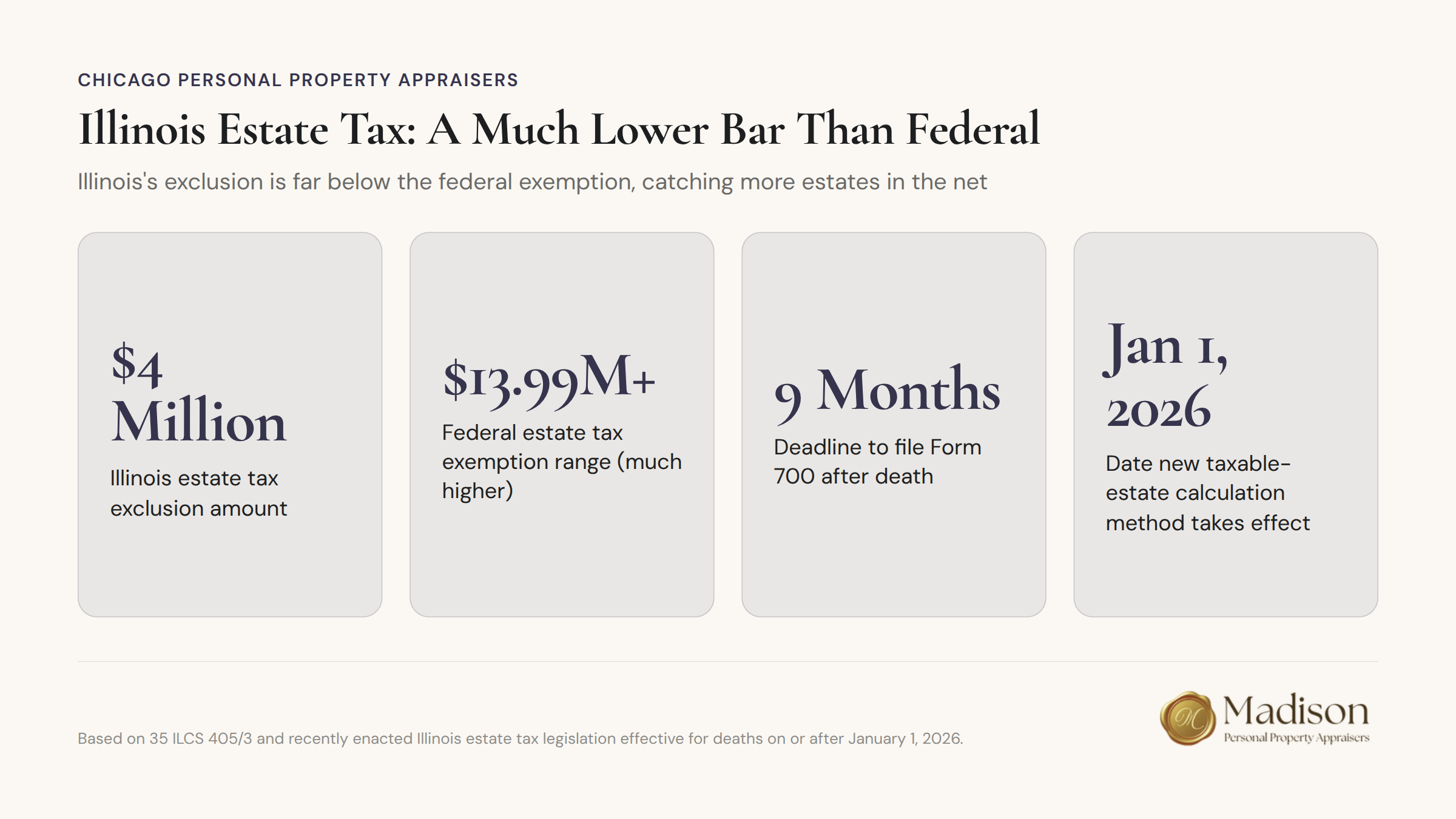
Illinois uses a $4 million exclusion amount, and any gross estate above that figure (after adjusted taxable gifts are added back in) owes Illinois estate tax and must file a return. For decedents who died before January 1, 2026, the tax was calculated through a state-death-tax-credit framework built into 35 ILCS 405/3. Recently enacted legislation changes the calculation method for deaths on or after January 1, 2026: the tax is now based on the Illinois taxable estate multiplied by the applicable Illinois estate tax rate, with the taxable estate built from the federal gross estate and reduced by a $4 million deduction under the amended statutory language. No Illinois estate tax is owed once the resulting taxable estate is zero or less.
The practical upshot: the $4 million line stays the relevant number regardless of when the death occurred, but the mechanics behind it changed in 2026, so the decedent's date of death determines which calculation applies. Above that $4 million exclusion, Illinois taxes the balance on a graduated rate structure, meaning the rate steps up as the taxable estate grows rather than applying a single flat percentage.
How Personal Property Counts Toward the Illinois Taxable Estate
Personal property isn't automatically excluded from the Illinois estate tax; it's counted at fair market value on the date of death, the same standard used for federal estate tax purposes. Whether a specific item ends up in the Illinois taxable estate depends on what kind of property it is, where it's physically located, and whether the decedent was an Illinois resident.
Tangible personal property, meaning physical items you can touch, generally follows a location rule:
- Art, jewelry, antiques, vehicles, furniture, and collections physically located in Illinois are treated as Illinois-situs property and are included in the Illinois taxable estate.
- For an Illinois resident, tangible personal property that is physically located outside Illinois is specifically excluded from Illinois situs under Section 5 of the Act.
- For a nonresident decedent, Illinois generally only reaches Illinois-situs real estate and tangible personal property physically located within the state.
Intangible personal property, such as bank accounts, securities, and business interests, is treated differently. For an Illinois resident, intangible property is generally sourced to the decedent's residence and included in the Illinois estate regardless of where the assets are actually held. For a nonresident, intangible property is generally outside the Illinois estate tax base entirely.
This distinction between tangible and intangible property is exactly why a valuable collection can matter more than a bank balance of the same size. A $500,000 art collection housed in a Chicago condo is Illinois-situs property that counts toward the estate regardless of the owner's residency. The same amount sitting in a brokerage account might be treated differently depending on where the decedent lived.
Filing Form 700 and the Nine-Month Deadline
When an Illinois estate's gross value, including adjusted taxable gifts, exceeds the $4 million exclusion, the estate must file Illinois Form 700 with the Illinois Attorney General's office. This filing is required even when the estate falls under the federal threshold and no federal Form 706 is due. The return is generally due within nine months of the date of death, mirroring the federal filing timeline, and the administrative process for the return is set out in 86 Illinois Administrative Code Part 2000.
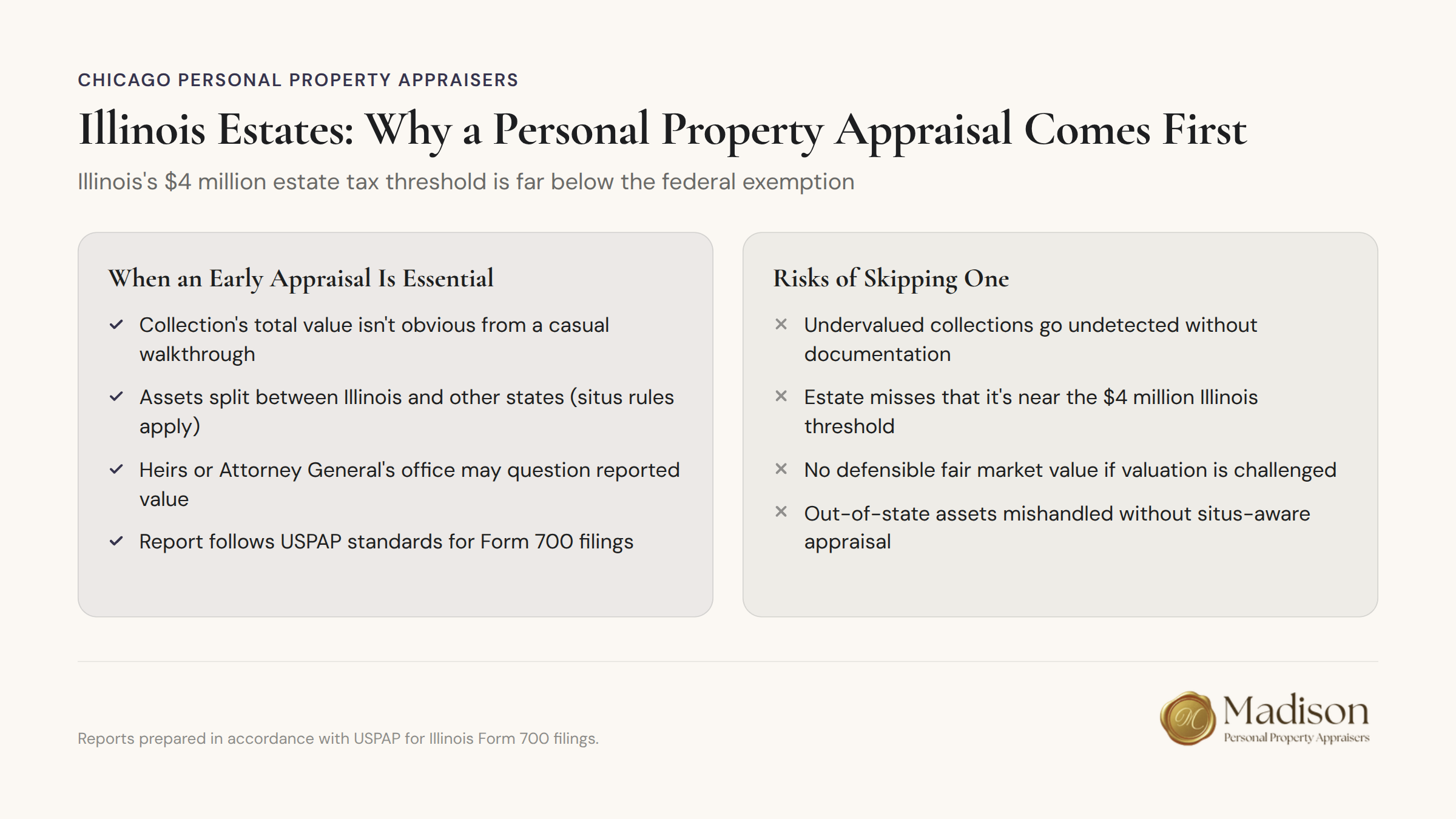
Missing this filing, or filing it with an inaccurate valuation, creates real exposure. Executors who assume an estate is safely under the federal exemption sometimes skip the appraisal work entirely, only to discover later that Illinois's much lower threshold applied all along.
Watch out: Executors sometimes rely on a rough estimate of a collection's worth rather than a documented appraisal. If the Illinois Attorney General's office questions the reported value on Form 700, an informal estimate offers no defense; a dated, methodology-backed appraisal does.
Why Executors Get a Personal Property Appraisal Early
A reliable personal property appraisal is the single tool that tells an executor whether an estate is even close to Illinois's $4 million line. Because the state threshold sits so far below the federal exemption, estates that never would have needed a federal valuation still need documentation for Illinois purposes.
Our appraisers prepare reports in accordance with USPAP so the fair market value figures reported on Form 700 hold up to scrutiny, whether the assets are fine art, jewelry, antique furniture, firearms, or a broader household collection. That documentation matters most when:
- The estate includes a collection whose aggregate value isn't obvious from a casual walkthrough of the home.
- Assets are split between Illinois and other states, since situs rules change how each piece is treated.
- Heirs or the Attorney General's office might later question the reported value.
If you're sorting through an Illinois estate and trying to figure out which items are worth a closer look before you file, our guide on which estate items need a professional appraisal walks through that triage process, and our overview of Cook County probate rules covers how the appraisal fits into the broader probate timeline.
Getting the Valuation Right Before You File
The core lesson here is simple: Illinois's $4 million exclusion is not a federal-sized safety margin, and personal property counts toward that number at full fair market value. An executor who assumes a modest estate is exempt because it's nowhere near the federal threshold can be wrong, sometimes by a wide margin, once a home's contents are properly valued.
Our team appraises the collections, jewelry, art, and household property that make up these estates, and we prepare reports built for the Form 700 filing process from the start. If you're settling an Illinois estate and need a documented valuation before the nine-month deadline, our estate tax appraisal service is the place to start.
This article is provided for general informational purposes only and does not constitute legal, tax, or financial advice. Readers should consult a qualified attorney or CPA regarding their specific circumstances.