
Blog
How Illinois Divides Personal Property in a Divorce Under State Law
Illinois courts divide personal property under an equitable distribution standard, not a 50/50 split, and the valuation date a court picks can change what an item is worth on paper. This guide explains the statute, the marital vs. non-marital line, and when a personal property appraisal divorce Illinois case actually needs one.
When a marriage ends in Illinois, the furniture, jewelry, art, and collections built up over the years don't split themselves. The law has a specific process for deciding what counts as marital property, how it gets valued, and how a judge divides it. This matters more than most people expect: the difference between a fair split and a lopsided one often comes down to who understood the rules, and who had a defensible number to back up their position.
Illinois Is an Equitable Distribution State, Not Community Property
Illinois divides marital property under an equitable distribution standard, not a community property rule. That distinction changes everything about how personal property gets split.
In a community property state, each spouse automatically owns half of everything acquired during the marriage, and a divorce simply divides that 50/50. Illinois works differently. Courts divide marital property in "just proportions," considering a list of statutory factors, which can mean 50/50 in many cases but frequently does not, especially when incomes, contributions, or custody arrangements are unequal. This equitable distribution approach is confirmed across current Illinois-focused legal guidance, which draws a clear line between the two systems used across the U.S. (atclaw.com).
The governing law is the Illinois Marriage and Dissolution of Marriage Act, specifically 750 ILCS 5/503. This statute is the starting point for every personal property dispute in an Illinois divorce, from a car and a coin collection to a piano that's been in the family for three generations.
Because the process starts with documenting what each spouse owns, many Illinois families begin by working through a personal property appraisal for estate tax style inventory even before the divorce filing, just to understand what's actually in the marital estate.
What Counts as Marital vs. Non-Marital Personal Property?
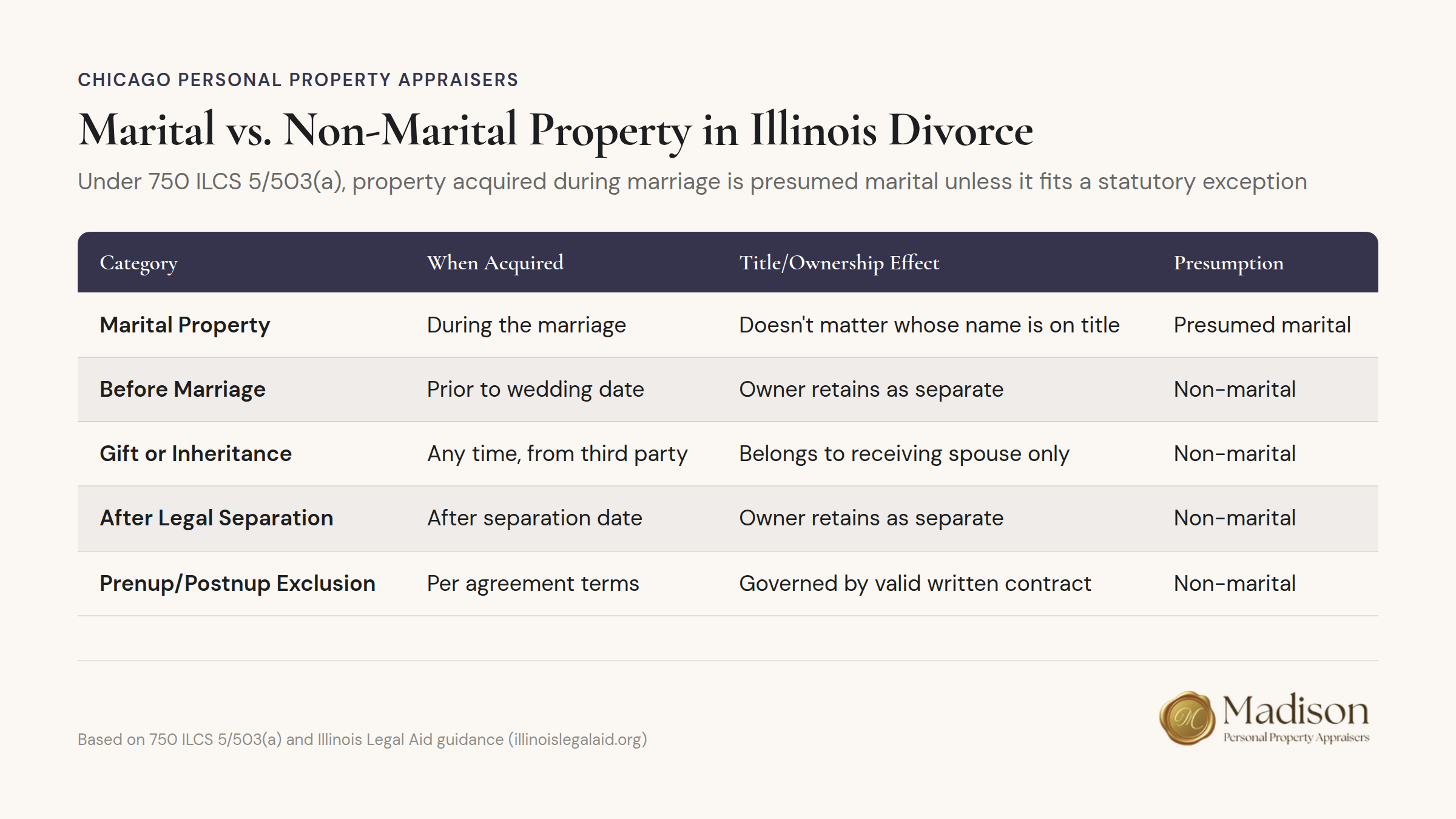
Marital property under Illinois law is presumed to be anything either spouse acquired during the marriage, regardless of whose name is on the title. Non-marital property falls into a narrower set of statutory exceptions.
Under 750 ILCS 5/503(a), the main non-marital categories are:
- Property acquired before the marriage began.
- Property acquired by gift, legacy, or inheritance from someone other than the spouse.
- Property acquired after a legal separation.
- Property specifically excluded by a valid prenuptial or postnuptial agreement.
Everything else acquired between the wedding date and the divorce judgment is presumed marital, even if only one spouse's name appears on the title, receipt, or registration. Illinois Legal Aid's public guidance confirms this presumption applies regardless of how title is held, meaning a ring purchased solely on one spouse's credit card, or a truck registered to one name, can still count as marital property subject to division (illinoislegalaid.org).
A spouse who wants to claim an item as separate property carries the burden of proving it fits one of those exceptions. That's a real burden, not a formality, and it's one reason inherited jewelry or family heirlooms often become contested points in a divorce.
How Courts Decide What's Fair: The Statutory Factors
Equitable does not mean automatic or equal. Illinois courts weigh a set of statutory factors before dividing marital personal property, and no single factor controls the outcome.
Those factors include each spouse's contribution to acquiring or preserving the property, any dissipation or waste of marital assets, the length of the marriage, each party's economic circumstances at the time of division, the tax consequences of the split, and any related maintenance award. Illinois family law practitioners describe this factor-based approach as the mechanism that produces a division in "just proportions" rather than a strict half-and-half outcome (sterlinglawyers.com).
In practice, this means two divorces with an identical pile of marital property, an art collection, a wine cellar, a set of vintage watches, can end with very different splits depending on the length of the marriage and each spouse's financial position going forward.
When Is Personal Property Valued? The Date-of-Valuation Rule
There is no single fixed date for valuing marital personal property in Illinois. Under 750 ILCS 5/503(f), courts have discretion to value marital property as of the date of trial, a date close to trial, or another date the parties agree to or the court orders.
That flexibility matters because the value of the same item can shift meaningfully depending on which date applies. A stock portfolio moves with the market. A classic car's value can climb or drop with collector demand. A jewelry collection's insured value at the time of separation may look nothing like its resale value two years later at trial. Illinois divorce practice guides describe this valuation step, assigning current values to disclosed assets, as a distinct phase that follows financial disclosure and precedes the final division (divorcenet.com).
Watch out: Because the statute doesn't mandate a fixed date like the date of separation, one spouse's attorney may push for an earlier date if an asset has appreciated, while the other pushes for trial date if it's depreciated. A personal property appraisal needs to state its effective valuation date clearly so it actually matches what the court has ordered, or it may not hold up as evidence.
Why Jewelry, Art, and Collectibles Need a Neutral Appraisal
Jewelry, fine art, and collectibles are the categories most often disputed in an Illinois divorce because there's no public market price to check the number against. A car has resale comps. A brokerage account has a statement. A diamond ring or a mid-century art piece has neither, which gives each spouse an incentive to name a number that favors their side of the split.
A spouse who wants to keep an item has a reason to argue it's worth less than it is, so they pay a smaller offset to the other party. A spouse being bought out has the opposite incentive, arguing the item is worth more. Without an independent number, both positions are just opinions, and opinions don't hold up well in a contested hearing.
This is where a neutral, third-party personal property appraisal earns its place in the case. A qualified appraiser has no stake in which spouse keeps the item and no financial interest in the outcome, so neither side can credibly claim the figure was inflated or deflated to favor the other party. Reports prepared in accordance with USPAP (the Uniform Standards of Professional Appraisal Practice) give both attorneys and the court a documented, defensible fair market value they can rely on instead of dueling estimates.
What the Report Needs to State
A divorce appraisal isn't just a number. To be useful in court, it needs to specify:
- The effective valuation date, matched to what the court has ordered under 750 ILCS 5/503(f), whether that's the trial date or another agreed date.
- The methodology used to reach fair market value for each item or category.
- Supporting documentation and comparables, especially for art, jewelry, and collectibles where no single public price exists.
Because divorce appraisals aren't a standardized service category with a published price list, the fee for this kind of engagement is quoted as a fixed fee after we scope the assignment, based on the number of items, the categories involved, and whether the report needs to meet a specific court deadline. Engagements are always fixed-fee and agreed before work begins, never billed by the hour.
Getting a Defensible Number Before You Go to Court
Dividing personal property in an Illinois divorce comes down to two questions: what counts as marital property, and what is it actually worth on the date that matters. The statute answers the first question with a presumption and a short list of exceptions. The second question is where a neutral appraisal earns its keep, particularly for jewelry, art, and collectibles that don't trade on a public market.
Families working through a contested estate often run into the same valuation questions in Cook County probate matters, where courts likewise need an independent, dated fair market value rather than a party's own estimate. If you're heading into a divorce and need a personal property appraisal that stands up to scrutiny from both attorneys and the court, request an appraisal and we'll walk you through what the engagement will cover.
This article is provided for general informational purposes only and does not constitute legal, tax, or financial advice. Readers should consult a qualified attorney regarding their specific circumstances.