
Blog
Form 8283 Section A vs Section B: Which One Applies to Your Chicago Donation?
Whether your noncash donation needs IRS Form 8283 Section A or Section B comes down to one number: $5,000. This guide walks Chicago donors through the test, the exceptions, and what a Section B appraisal requires before you file.
What Triggers Form 8283 for a Chicago Donation?
You must file Form 8283 whenever your total deduction for noncash charitable contributions in a tax year is more than $500, including a group of similar items that together exceed $500, according to the IRS Instructions for Form 8283. That $500 filing threshold is separate from the $5,000 threshold that decides which section of the form you fill out. Miss the filing requirement entirely and the IRS can disallow the deduction before it ever looks at value.
If you're donating a furniture collection, artwork, jewelry, or a library of books to a Chicago nonprofit or museum this year, the form itself is only part of the picture. Our personal property appraisal services for charitable donations exist specifically to document fair market value in the format the IRS expects, and our Chicago appraisers handle both the valuation and the paperwork that supports it.
Section A vs Section B: The $5,000 Test
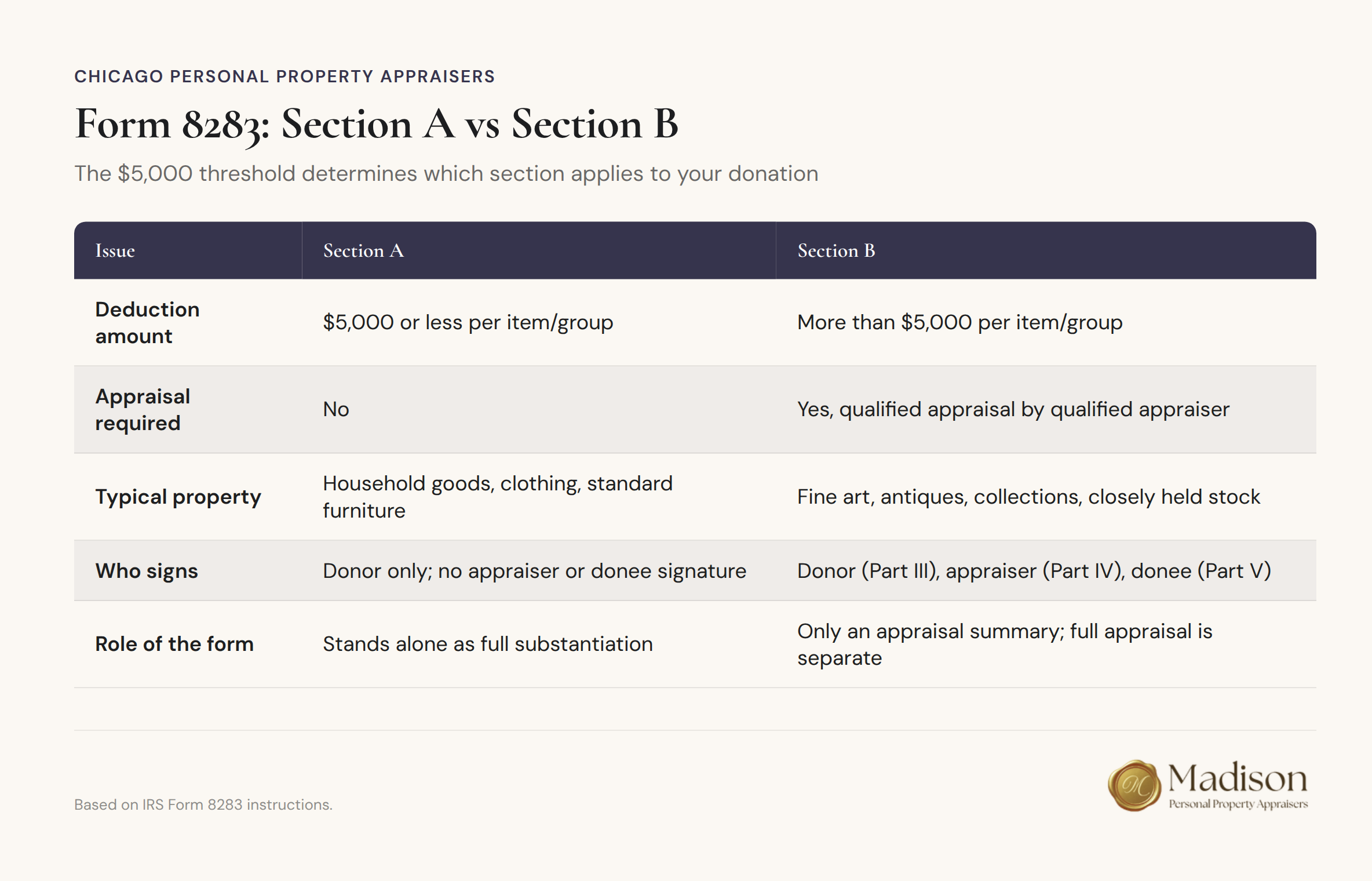
The core rule is simple: Section A covers an item or group of similar items where the claimed deduction is $5,000 or less. Section B covers an item or group of similar items where the claimed deduction is more than $5,000. Section A requires no appraisal. Section B generally requires a written qualified appraisal prepared by a qualified appraiser before the form can be validly completed.
| Issue | Section A | Section B |
|---|---|---|
| Deduction amount | $5,000 or less per item or group | More than $5,000 per item or group |
| Appraisal required | No | Yes, a qualified appraisal by a qualified appraiser |
| Typical property | Household goods, clothing, standard furniture, everyday collectibles | Fine art, antiques, significant collections, closely held stock |
| Who signs | Donor reports the property; no appraiser or donee signature | Donor (Part III), appraiser (Part IV), and donee organization (Part V) |
| Form 8283 itself | Stands alone as the substantiation | Functions only as an appraisal summary; the full appraisal is a separate document |
The distinction matters because Section B is a stricter filing. A separate Section B Form 8283 is generally required for each item, unless the property qualifies as part of a group of similar items, and a separate form is required for each donee organization that receives more than $5,000 in aggregated similar property.
Exceptions That Keep an Item in Section A No Matter the Value
A handful of property types stay in Section A even when the deduction exceeds $5,000. These exceptions exist regardless of how the general dollar test would otherwise classify the property:
- Publicly traded securities with daily published market quotations, no matter the deduction amount.
- Certain intellectual property covered under the specific statutory provision for patents and similar assets.
- A qualified vehicle for which the deduction is limited to gross proceeds from its sale and the donor has a contemporaneous written acknowledgment from the charity.
- Inventory or property held for sale in the ordinary course of a trade or business.
Donors occasionally assume that a high-value item automatically means Section B. That isn't always true. What are the requirements for filing Form 8283? walks through how these classification rules interact with the general $5,000 test in more depth.
Watch out: Donating appreciated stock worth $8,000 still belongs in Section A if it's publicly traded with a readily available quote. Treating it as a Section B item wastes the cost of an appraisal you don't need.
Three Triggers That Always Push You Into Section B
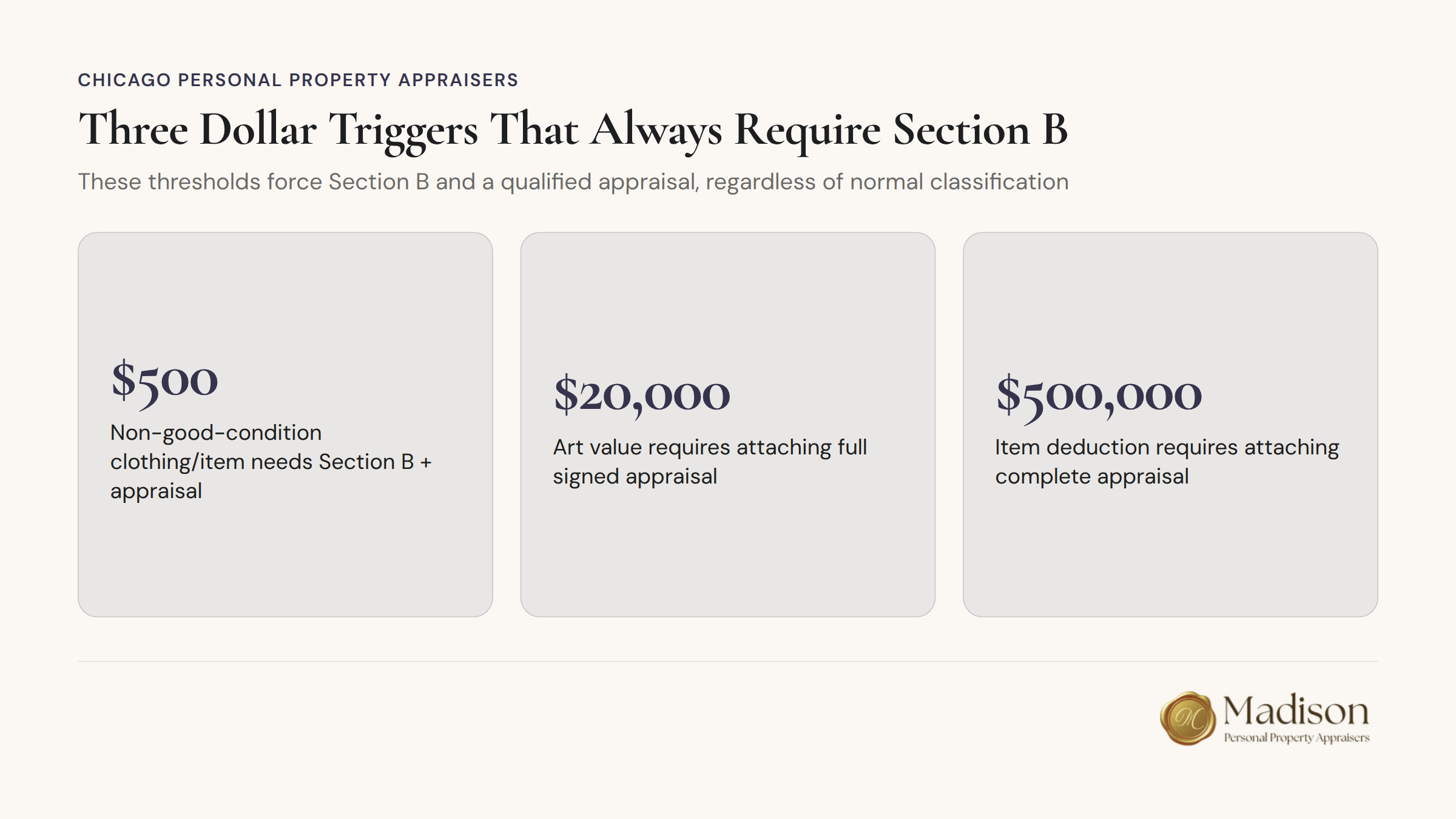
Three specific situations require Section B and a qualified appraisal regardless of how the item would otherwise be classified. A single article of clothing or a single household item not in good used condition, claimed at more than $500, always requires Section B and an appraisal, even though the dollar amount is well under $5,000. Art valued at $20,000 or more requires attaching a complete copy of the signed appraisal itself to the return, not just the summary. Deductions of more than $500,000 for any item require attaching the full qualified appraisal to the return as well.
What Counts as a "Similar Item" and Why Aggregation Matters
"Similar items of property" means items of the same general category or type: a coin collection, a group of paintings, a run of first-edition books, a set of jewelry, or a block of nonpublicly traded stock. The $5,000 test isn't applied item by item in isolation. It's applied after you add up the value of every similar item you donated during the year, even if the individual pieces were given to different organizations.
Example: A Lincoln Park family clears out a parent's estate and donates a furniture collection worth $3,200 to one Chicago nonprofit's resale program, then donates another $2,400 worth of similar furniture pieces to a second Chicago charity later the same year. Individually, each gift looks like Section A territory. Added together, the furniture totals $5,600, which pushes the whole group into Section B, and the donor must file a separate Section B Form 8283 for each of the two donee organizations.
A Hyde Park collector donating three paintings worth $7,000, $9,500, and $4,000 to a local art museum faces the same math from the other direction. The paintings are similar items (artwork), the combined claimed deduction is well past $5,000, and Section B applies to the whole group even though one painting alone was under the threshold.
Pro tip: Before you assume a donation is small enough for Section A, add up everything in the same general category that you gave away during the tax year, not just the single item in front of you.
Completing Section B: The Three Signatures That Make It Valid
A Section B Form 8283 isn't valid until three separate parties sign it. Part III is the taxpayer's statement from the donor. Part IV is the declaration of the appraiser, confirming the qualifications and the appraisal itself. Part V is the donee acknowledgment, which the receiving Chicago nonprofit or museum must complete and sign to confirm it received the property described.
An incomplete Section B form, missing any one of these three signatures, can result in the IRS disallowing the deduction unless the donor can show the failure was due to reasonable cause rather than willful neglect. This is one of the most common reasons a technically correct appraisal still runs into trouble at filing time, and it's a large part of why we coordinate directly with the receiving organization on timing.
When Does the Qualified Appraisal Need to Be Finished?
A qualified appraisal does not need to exist on the date you make the donation. It needs to be received no later than the due date, including extensions, of the return on which the deduction is first claimed, or the date an amended return is filed if the deduction is claimed there instead. That gives donors breathing room to arrange an appraisal after the gift, as long as it's wrapped up well before the filing deadline.
Key takeaway: The $5,000 line on the claimed deduction, not the item's sticker price or your own estimate of value, is what decides Section A versus Section B. Everything else, from aggregation rules to the signature requirements, flows from that one number.
Getting the Appraisal Right Before You File
Our appraisers hold credentials with organizations including the ISA, ASA, AAA, and CAGA, and every charitable donation report we prepare is built in accordance with USPAP so it holds up under IRS scrutiny. If you're planning a donation to a Chicago nonprofit, museum, or university and you're not sure whether Section A or Section B applies, the safest move is to get the valuation question answered before you sign anything. Request an appraisal and we'll help you figure out exactly what Form 8283 requires for your specific gift.
This article is provided for general informational purposes only and does not constitute legal, tax, or financial advice. Readers should consult a qualified attorney or CPA regarding their specific circumstances.