
Blog
What Cook County, Illinois Probate Law Says About Personal Property Appraisals
Illinois probate law requires a fair-market-value inventory of a decedent's personal property, and Cook County estates follow specific rules on administration type, filing deadlines, and when a professional appraisal is required. This guide breaks down the $150,000 small estate threshold, the 60-day inventory deadline, and exactly when executors need a qualified personal property appraisal.
When someone dies owning personal property in Cook County, that property does not distribute itself. Illinois probate law sets the rules for how it gets inventoried, valued, and eventually passed to heirs, and the process looks different depending on the size of the estate and the type of administration the court opens. This guide walks through what happens to a decedent's personal property during Illinois probate, when a full court-supervised process applies versus a streamlined one, and exactly when the estate needs a professional personal property appraisal rather than an executor's best guess.
If you are handling probate as an executor, administrator, or heir and want to understand how to value the decedent's belongings, our guide on how to value personal possessions for probate covers the mechanics in more depth. This article focuses specifically on the Cook County, Illinois context: the statute, the local court rule, and the practical thresholds that determine what you actually need to do.
What Happens to Personal Property During Illinois Probate?
Under Illinois law, a decedent's personal property becomes part of the probate estate, and the appointed representative is responsible for identifying it, valuing it, and reporting it to the court before any distribution to heirs. The controlling framework is the Illinois Probate Act of 1975 (755 ILCS 5), and in Cook County that process runs through the Probate Division of the Circuit Court of Cook County.
The representative's core job with respect to personal property is straightforward in concept, even when the estate itself is complicated:
- Locate and take possession of the decedent's tangible personal property (furniture, jewelry, art, vehicles, collections, household goods).
- Determine the fair market value of that property as of the date of death.
- Report the property and its value in a verified inventory filed with, or retained for, the court.
- Distribute the property according to the will or, absent a will, Illinois intestacy rules.
How closely the court watches this process, and how much documentation you need to produce, depends heavily on which type of administration the estate falls under.
Independent vs Supervised Administration in Cook County
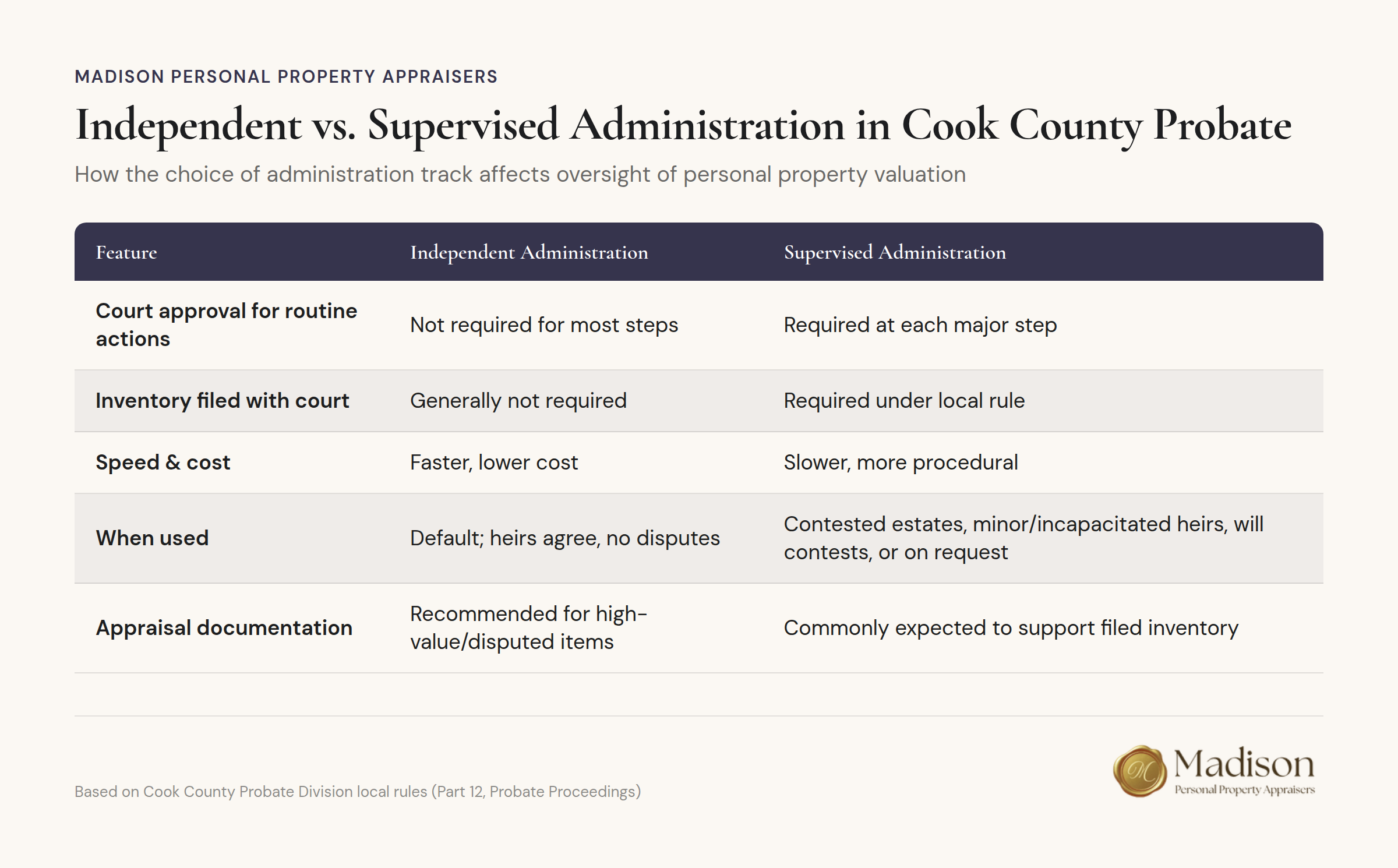
Illinois offers two tracks for administering an estate, and the choice affects how much oversight your personal property valuation gets. Independent administration is the default and far more common path: it lets the representative act without routine court approval for most transactions, including handling and distributing personal property. Supervised administration keeps the court actively involved in every material step, and it is the track most likely to require the representative to formally file an inventory with the court under Cook County's local probate rules.
| Feature | Independent Administration | Supervised Administration |
|---|---|---|
| Court approval for routine actions | Not required for most steps | Required at each major step |
| Inventory filed with the court | Generally not required to be filed | Required under Cook County's local rule |
| Speed | Faster, lower cost | Slower, more procedural |
| When it is used | Default when heirs and beneficiaries agree, no unusual disputes | Contested estates, minor or incapacitated heirs, will contests, or when a party requests it |
| Appraisal documentation expectations | Recommended for high-value or disputed items | Commonly expected to support the filed inventory |
Cook County's Probate Division rules describe the procedural expectations for probate proceedings in more detail, including how supervised matters move through the court calendar. Most Cook County estates open under independent administration because it is faster and less expensive, but a court can order supervised administration on its own motion or at the request of an heir, creditor, or other interested party if there is a dispute over the estate's assets or their value.
The Illinois Small Estate Affidavit: $150,000 Threshold
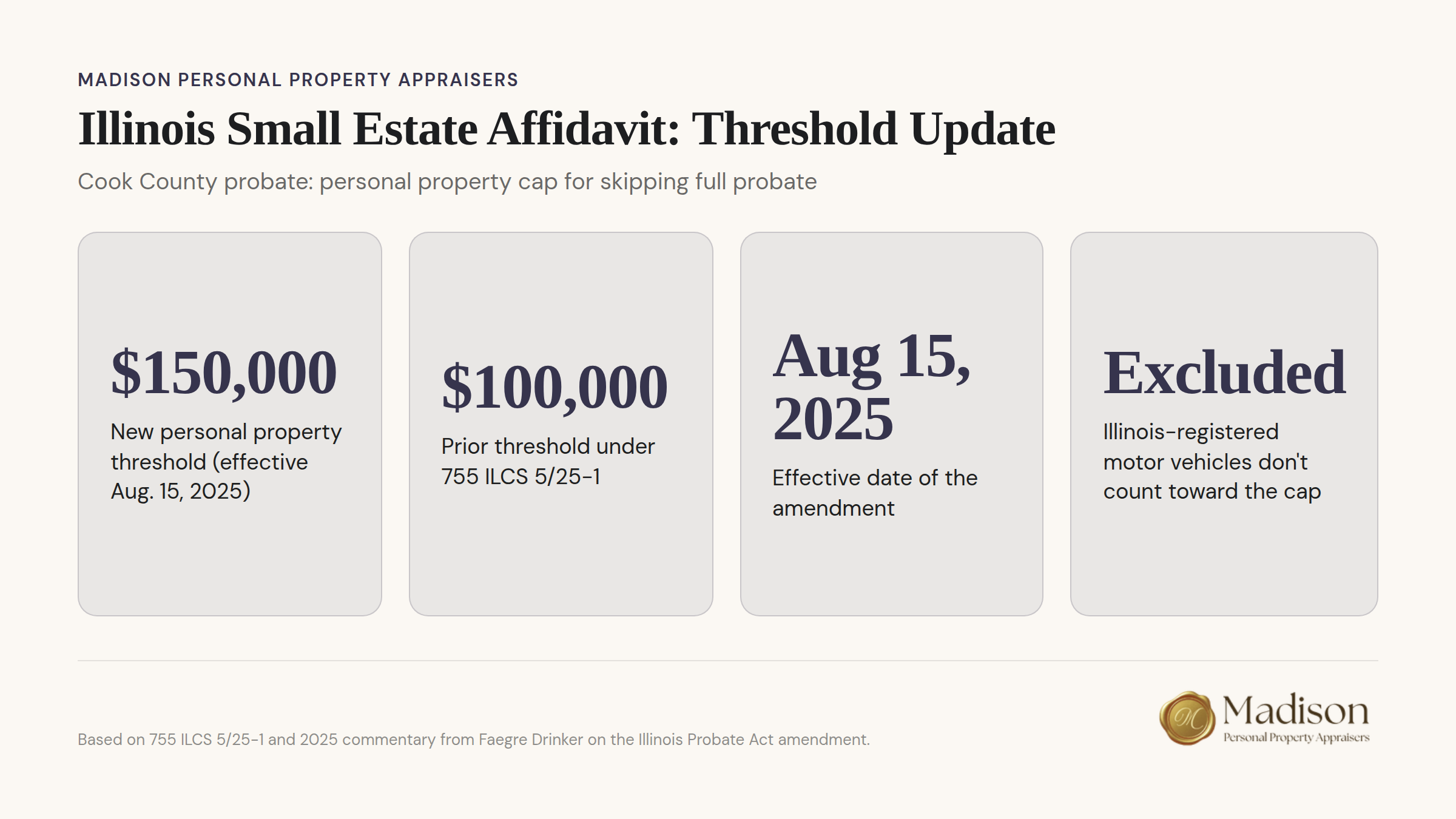
Not every estate needs to go through probate at all. Illinois allows a small estate affidavit process when the decedent's personal estate falls under a statutory dollar threshold, and that threshold recently changed. Effective August 15, 2025, the cap rose to $150,000 in personal property value, excluding motor vehicles registered with the Illinois Secretary of State, up from the previous $100,000 limit under 755 ILCS 5/25-1.
The practical effect: if the total value of the decedent's tangible and intangible personal property (bank accounts, household goods, jewelry, collections, and similar assets, but not registered vehicles) comes in at or under $150,000, and there is no real estate requiring probate, an heir or representative can often use a sworn small estate affidavit to collect and distribute assets without opening a full probate case. This shift is a meaningful one for mid-sized Cook County estates that previously would have crossed into full probate territory, and recent legal commentary on the 2025 amendment walks through the change in more detail.
Watch out: The $150,000 threshold is based on the value of the personal estate, not the estate's total worth including real property. An estate with modest bank accounts but a valuable art collection, coin collection, or jewelry inventory can cross the threshold faster than families expect, which is exactly the situation where an independent appraisal earns its cost by giving the affidavit a defensible number behind it.
The 60-Day Inventory Deadline and Cook County's Filing Rule
Once a probate case opens and letters of office are issued, the clock starts running on the inventory. Illinois law requires the representative to prepare a verified inventory of the decedent's real and personal estate within 60 days after letters are issued, with a supplemental inventory required within 60 days of discovering any later assets, under 755 ILCS 5, Article XIV. That same article gives the representative discretion to appraise goods and chattels personally or to engage one or more competent, disinterested appraisers and pay them reasonable compensation from the estate.
What changes in Cook County is whether that inventory actually gets filed with the court. Under Cook County's local probate rule, formal filing of the inventory with the court is generally required in supervised administration, where the judge is actively reviewing the estate's assets, but it is generally not required to be filed in independent administration, where the representative keeps the inventory on hand and produces it if a beneficiary or the court asks for it.
Pro tip: Even when Cook County does not require you to file the inventory, keep it anyway, and keep it thorough. Beneficiaries have the right to request an accounting, and a well-documented, professionally supported inventory is the fastest way to head off a dispute before it becomes a court filing.
When Does a Cook County Estate Need a Professional Personal Property Appraisal?
Illinois law does not require a licensed appraiser for every estate. The statute gives the representative the option to value goods and chattels personally or to hire a competent, disinterested appraiser when the situation calls for it. In practice, a handful of situations reliably call for it.
- Heirs disagree on value. When siblings or beneficiaries dispute what an item or collection is worth, an independent, third-party number resolves the argument faster than continued negotiation.
- High-value or specialized items are involved. Art, jewelry, antiques, firearms, and collections (coins, stamps, memorabilia) require category-specific market knowledge that a general estimate rarely captures accurately.
- The estate is taxable or near a taxable threshold. Estates approaching federal or state estate tax thresholds need a defensible, well-documented valuation to withstand review.
- The court has ordered supervised administration. A judge overseeing a supervised estate typically expects the filed inventory to be supported by credible valuation work, not an executor's rough guess.
Our team of appraisers prepares USPAP-compliant personal property appraisals for estate and probate matters for Cook County families in exactly these situations, whether the goal is a defensible inventory for the court, a number both heirs can agree on, or documentation to support an estate tax filing. Appraisers holding credentials with organizations such as the ISA, ASA, and AAA follow the same fair-market-value standard the Probate Act contemplates, which keeps the report consistent whether it ends up supporting a small estate affidavit or a fully supervised probate inventory.
Fair Market Value: the Standard for Date-of-Death Valuation
Illinois probate values personal property at fair market value, generally as of the date of death, which is the same core standard used in federal estate tax valuation and in property tax administration across the state. Fair market value means the price a willing buyer would pay a willing seller, with neither party under compulsion to act and both reasonably informed of the relevant facts, a standard the IRS applies to household and personal effects in federal estate valuation and one that the International Society of Appraisers uses as the foundation of its own valuation methodology.
As a matter of general industry practice, not a specific Illinois statute, appraisers and estate professionals sometimes reference the federal concepts behind IRC Section 2031 and Section 2032, which govern how estate property is valued and the limited circumstances allowing an alternate valuation date roughly six months after death. Illinois probate does not incorporate these federal alternate-date provisions directly, but the underlying fair-market-value logic they share with Illinois law is why a properly documented appraisal holds up whether it is used for a state probate inventory, a federal estate tax return, or an equitable distribution among heirs.
Example: An estate includes a jewelry collection two heirs disagree about. One believes it is worth $8,000 based on insurance replacement estimates; the other thinks it is closer to $3,000 based on what a local pawn shop offered. A qualified appraisal, grounded in date-of-death fair market value and actual comparable sales, resolves the gap with a defensible number both the estate and the court can rely on.
Getting the Inventory Right the First Time
Cook County probate does not demand a professional appraisal for every estate, but it rewards families who get the valuation right the first time. A rushed or informal estimate can trigger disputes among heirs, invite scrutiny in a supervised case, or leave a taxable estate exposed if the IRS questions the reported values later. Whether your estate is small enough for a affidavit or headed into full independent or supervised administration, having a fair-market-value inventory prepared to a defensible standard protects the representative and the heirs alike.
Our appraisers work with Cook County executors and families to prepare fixed-fee, USPAP-compliant personal property appraisals for probate inventories, estate tax filings, and disputes among heirs. If you are managing a Cook County estate and need a defensible valuation of the decedent's personal property, you can request an appraisal to get the process started.
This article is provided for general informational purposes only and does not constitute legal, tax, or financial advice. Readers should consult a qualified attorney or CPA regarding their specific circumstances.