
Blog
Chicago Charities and Museums That Accept Art, Antique, and Collection Donations
Chicago museums, university collections, and general donation centers each accept art and antiques under different terms, and knowing which one fits your item matters before you make a call. This guide walks through what each recipient type typically accepts and where a qualified appraisal fits into your tax deduction.
Donating a painting to a museum is a very different transaction than dropping off a box of household goods at a thrift store, even though both can technically qualify as a charitable contribution. Chicago donors looking to place fine art, antiques, or a lifetime collection with the right institution need to understand three distinct paths: major museums, university and academic collections, and general charity donation centers. Each has its own intake process, and each carries the same underlying tax mechanics once a donation crosses certain dollar thresholds.
This guide walks through what each type of recipient typically accepts, how the process generally works, and where a qualified appraisal for a charitable donation fits into the picture no matter which institution ends up with your item.
Major Chicago Museums: The Art Institute of Chicago, Chicago History Museum, and the Field Museum
Large museums accept art, historical objects, and collections only when the piece fits an existing collecting area and advances the institution's mission. A museum is not a general drop-off point: donations typically move through a curatorial review, where staff evaluate whether the object has scholarly, artistic, or historical significance to the collection before anyone discusses accepting it.
The Art Institute of Chicago and the Chicago History Museum both maintain formal collections departments that review proposed gifts against their existing holdings and current collecting priorities. If a curator recommends acceptance, the donor typically signs a deed of gift, a document that formally transfers legal title and any reproduction rights to the museum. The Field Museum of Natural History follows a comparable structure and publishes some of the clearest public language among Chicago institutions on how it treats these gifts for tax purposes: it distinguishes between property put to a "related use" (an object that supports the museum's exempt purpose, such as artwork given to an art museum) and property that is not, a distinction that directly affects how much of the fair market value a donor can deduct according to the Field Museum's planned giving guidance.
A few practical realities apply across all three institutions and most peer museums:
- Curatorial fit matters more than value. A valuable object outside the museum's collecting scope is more likely to be declined than a modest item that fills a genuine gap.
- Contact happens through a formal channel. Museums generally direct prospective donors to a curatorial department, registrar, or gift planning office rather than a general inquiry line.
- Some departments pause new acquisitions. Museums periodically stop accepting gifts in a given category while they focus on cataloging existing holdings or reassess storage capacity.
- The museum does not appraise your gift. Curatorial staff can confirm interest in an object, but they are not positioned to provide the donor's tax valuation.
University and Academic Collections in the Chicago Area
Chicago is home to several universities with teaching collections, special collections libraries, and museum-adjacent archives that accept art, rare books, manuscripts, and historical objects tied to their academic mission. These collections often welcome gifts that support coursework or research, such as prints and drawings for an art history department, scientific instruments for a history-of-science program, or archival papers and photographs for a special collections library.
The process resembles museum intake in most respects: a curator or collections librarian reviews the proposed gift for relevance, the donor completes a deed of gift, and the institution retains discretion over whether an item advances its academic use case. Because university collections are often narrower in scope than a general museum, fit tends to matter even more here. A donor with a broad collection of decorative arts may find that only a portion aligns with a given department's teaching needs, while the rest is better suited to a museum or general charity.
As with museums, a university collection is not equipped to provide the donor's tax appraisal. Its interest in the gift and its opinion of the object's scholarly value are separate questions from the fair market value the IRS requires for a deduction.
General Charity Donation Centers for Household-Level Valuables
Organizations such as Goodwill and the Salvation Army serve an entirely different function. They accept a high volume of household goods, clothing, furniture, and everyday items with no curatorial review and generally no deed of gift. Donors drop off items at a retail location or arrange a pickup, and the charity issues a general receipt describing the donation without assigning it a dollar value.
This path works well for the bulk of an estate's household contents, but it is a poor fit for genuinely valuable art, antiques, or collectibles. A general donation center is not staffed to recognize a significant piece of silver, a period antique, or a work by a listed artist, and its intake process is not built around preserving or documenting provenance the way a museum's is. Donors with a mixed estate often route higher-value pieces to a museum, university collection, or specialty resale channel, while sending the remaining household-level items to a general charity.
The Appraisal Requirement That Applies No Matter Where You Donate
Regardless of which recipient accepts your donation, the same IRS documentation rules govern your deduction once the value crosses certain thresholds. None of the three recipient types discussed above, museum, university collection, or general charity, provides or pays for the appraisal a donor needs to substantiate the deduction.
The relevant dollar thresholds are:
- Over $500 in total noncash contributions for the year: the donor must file Form 8283 with their tax return.
- Over $5,000 for a single item or group of similar items: the donor needs a qualified written appraisal and must complete Section B of Form 8283, with the appraiser's signature in Part III and the receiving organization's signature acknowledging receipt.
- $20,000 or more claimed for art: the IRS instructions for Form 8283 require a complete copy of the signed appraisal to be attached to the return, and the IRS may request photographs of the item.
The IRS defines "art" broadly for these purposes, covering paintings, sculptures, watercolors, prints, drawings, ceramics, antiques, decorative arts, textiles, carpets, silver, rare manuscripts, and historical memorabilia, which means most of what a Chicago donor might give to a museum or collection falls under these rules. Separately, IRS Publication 526 requires a contemporaneous written acknowledgment from the charity for any single donation of $250 or more, a requirement that runs alongside, not instead of, the appraisal rules above.
Museums and universities generally acknowledge receipt of a gift and may note that it will be put to a use related to their mission, since that supports the donor's fair market value claim, but they do not assign a dollar value in that acknowledgment. Valuation is the donor's responsibility, prepared by a qualified appraiser independent of the receiving institution. This is exactly the gap our team's qualified appraisal service for charitable donations is built to close: a USPAP-compliant, IRS-ready report the donor commissions before or shortly after the gift is made, so Section B is complete and the deduction is properly supported if the return is ever reviewed.
Comparing Your Options at a Glance
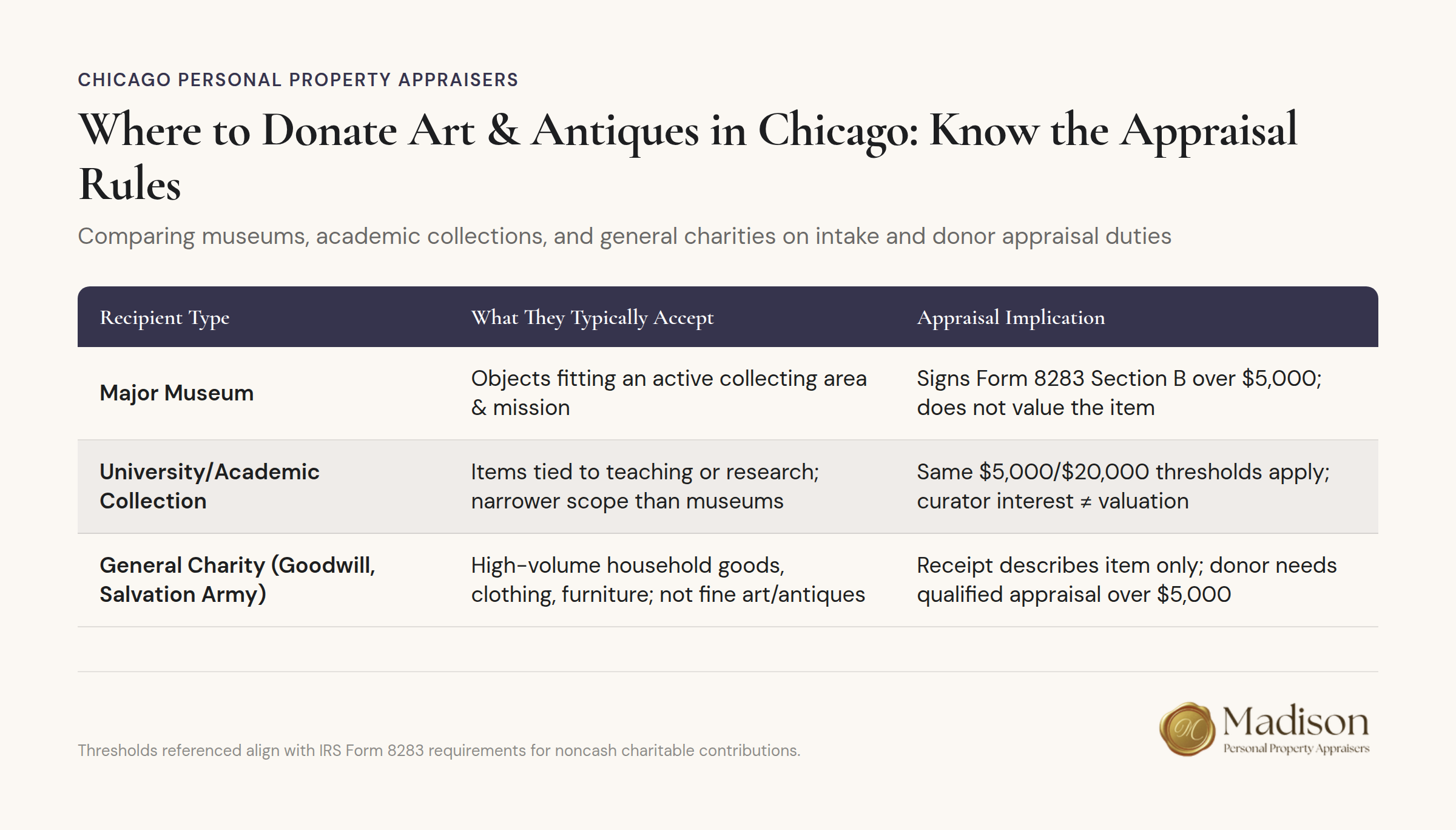
The table below summarizes how each recipient type generally handles intake and where the appraisal obligation sits.
| Recipient Type | What They Typically Accept | Appraisal Implication |
|---|---|---|
| Major museum (art, history, natural history) | Objects that fit an active collecting area and advance the mission | Museum reviews fit and signs Form 8283 Section B for gifts over $5,000; does not value the item for the donor |
| University or academic collection | Items tied to teaching or research use, often narrower in scope than a museum | Same $5,000 and $20,000 thresholds apply; curator's interest is not a valuation |
| General charity (Goodwill, Salvation Army) | High-volume household goods, clothing, furniture; not equipped for fine art or antiques | Receipt describes the item only; donor still needs a qualified appraisal for claims over $5,000 |
Confirm Acceptance Before You Assume Anything
Collecting priorities at any given museum or university change from year to year, and it is common for a department to pause new acquisitions in a specific category while it processes existing gifts or reassesses storage. Nothing in this guide should be read as confirmation that a particular Chicago institution is currently accepting donations in your item's category. That has to be confirmed directly with the institution's collections or gift planning office before you assume a donation will be accepted, and well before you make any decisions about disposing of related items.
The practical sequence for most donors looks like this: contact the institution to gauge interest, provide photographs and background on the piece, wait for a curatorial decision, and only then formalize the gift with a deed of gift. If the answer is no, or if a department is paused, a university collection or a specialty resale channel may still be interested even when a flagship museum is not. Our team's guide on what happens if the IRS questions a charitable donation appraisal covers what documentation to keep on hand once a gift is finalized, in case the deduction is ever reviewed.
Getting Your Valuation in Place Before You Donate
Whichever Chicago institution ends up with your art, antiques, or collection, the appraisal obligation sits with you, not with the museum, university, or charity. Lining up a qualified, independent appraisal before the gift is finalized keeps Form 8283 accurate, keeps the $20,000 attachment requirement covered if it applies, and gives you a defensible number if the IRS ever asks. Our appraisers prepare USPAP-compliant reports for donors across the Chicago area and can help you determine whether your item clears the $5,000 or $20,000 thresholds before you make the call to a museum's collections office. Request an appraisal to get your donation documentation in order.
This article is provided for general informational purposes only and does not constitute legal, tax, or financial advice. Readers should consult a qualified attorney or CPA regarding their specific circumstances.